Vacuum brazed diamond tools are a category of superhard tools designed for industrial grinding, cutting, and material removal—especially where stable diamond retention and process consistency are required. On this page, UHD Ultrahard Tools Co., Ltd explains the tool structure, the vacuum brazing principle, how diamond abrasive bonding works, and where these tools are typically applied in metalworking and stone processing.
A vacuum brazed diamond tool is a tool in which diamond abrasive particles are bonded to a metal tool body (substrate) through a brazing filler alloy under a controlled vacuum environment. The manufacturing approach focuses on forming a strong metallurgical bond between the abrasive and the substrate, enabling the tool to remove material effectively during processing.
In practical terms, the “vacuum brazed” concept highlights how the diamond is attached to the tool body—this attachment method is central to understanding performance differences versus conventional grinding/cutting tools.
The diamond particles are the primary material-removal elements. Their exposure at the working surface and the stability of retention influence cutting/grinding behavior during metalworking and stone processing.
The brazing alloy is responsible for creating the bond between diamond and substrate. In vacuum brazing, the process is designed to support strong bonding by reducing oxidation and promoting wetting/attachment during heating.
The tool body provides stiffness, geometry, and mounting compatibility (depending on the tool type). It also serves as the base material to which the diamond abrasive is bonded.
Engineering note: When discussing vacuum brazed diamond tools, “structure” typically refers to the abrasive + bond + substrate relationship. This is the foundation for tool selection conversations and feasibility checks.
Vacuum brazing is a joining process performed in a vacuum furnace. In the context of diamond tools, it is used to attach diamond abrasive to a tool body through a brazing alloy. The vacuum environment helps control contamination and oxidation, supporting more consistent bonding behavior compared with open-atmosphere heating.
This overview is intended for initial technical understanding; detailed parameters depend on tool design, materials, and application requirements.
The key differentiator is the bonding mechanism. Vacuum brazed diamond tools rely on a brazed joint to hold diamond particles on the substrate, which differs from many conventional tools that rely on resin/metal bonds in a grinding layer or other retention methods. Understanding the bonding concept helps engineers evaluate suitability for a given workpiece material, contact mode, and stability requirement.
| Comparison Dimension | Vacuum Brazed Diamond Tools | Conventional Grinding/Cutting Tools (general) |
|---|---|---|
| How diamonds are held | Brazing alloy forms a bond between diamond and substrate | Often relies on bonded grinding layers or other mechanical/chemical retention approaches |
| Manufacturing environment | Vacuum furnace cycle for controlled brazing | Varies by tool type (e.g., sintered, resin-bonded, plated, etc.) |
| What engineers evaluate | Bond integrity, abrasive exposure, suitability for target material removal mode | Bond type behavior, wear mechanism, surface finish needs, process constraints |
| Typical discussion outcome | Clarify whether vacuum brazed bonding matches the process window and workpiece | Select the appropriate tool family based on process, cost, and performance balance |
Note: This table is a high-level comparison to support early-stage selection; exact behaviors depend on tool design, abrasive specification, and operating conditions.
Vacuum brazed diamond tools are commonly discussed for industrial tasks where diamond abrasives are applicable and where the bonding method can support stable working behavior. UHD’s vacuum brazed diamond abrasive solutions are widely oriented to metalworking and stone processing scenarios.
Application fit reminder: The suitability of vacuum brazed diamond tools should be assessed against the workpiece material, target finish, machine capability, coolant/dry conditions, and the required removal rate—rather than relying on a one-tool-fits-all assumption.
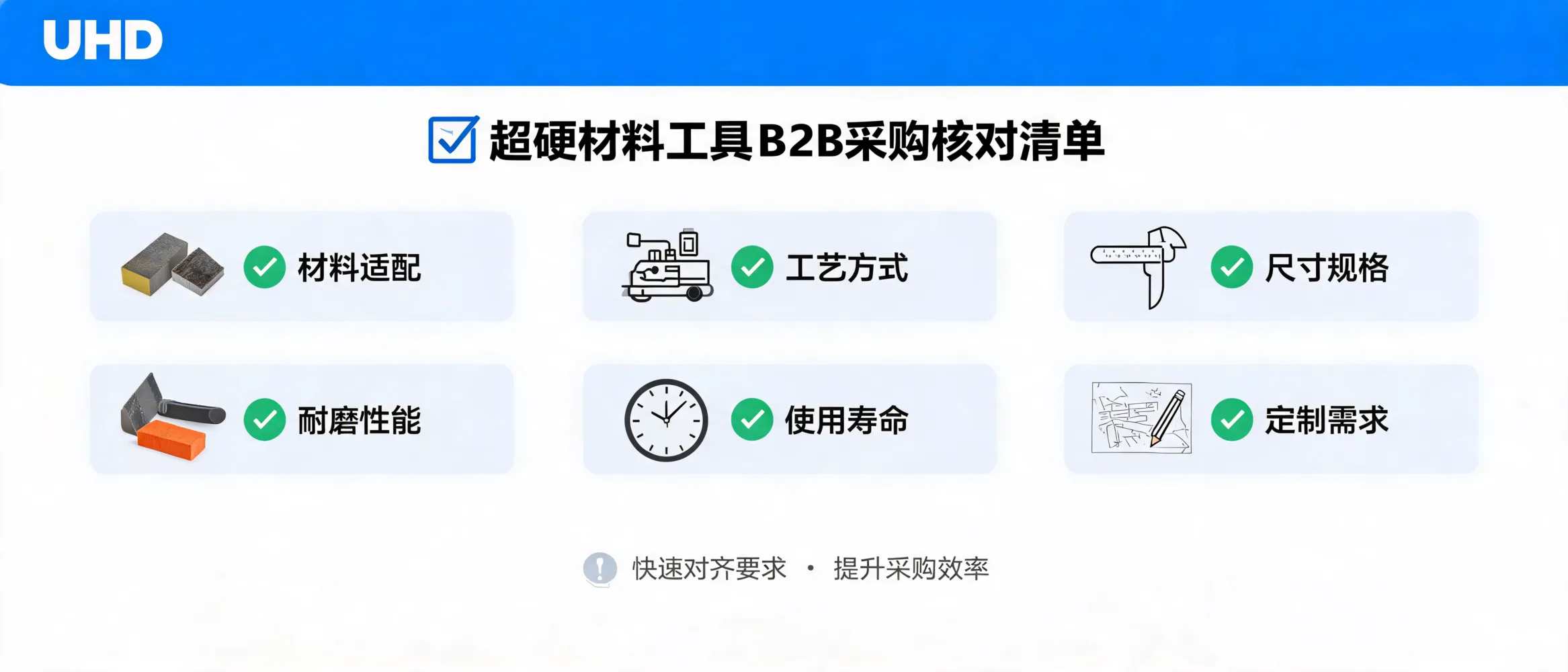
To help accelerate early-stage evaluation, UHD recommends aligning on the following inputs before confirming a vacuum brazed diamond tool type or specification:
UHD Ultrahard Tools Co., Ltd (Henan UHD Ultrahard Tools) is a high-tech enterprise focused on R&D, manufacturing, and B2B supply of superhard tools, including diamond tools, abrasive products, and custom vacuum brazed diamond abrasives. UHD collaborates with academic partners such as Henan University of Technology to support ongoing development in ultrahard cutting and grinding technologies, and serves global industrial customers through established international trade channels.
If you are evaluating vacuum brazed diamond tools for metalworking or stone processing, UHD can support technical communication around tool structure, bonding approach, and application suitability based on your process requirements.

.png?x-oss-process=image/resize,h_1000,m_lfit/format,webp)
.png?x-oss-process=image/resize,h_1000,m_lfit/format,webp)