For industrial buyers, sourcing vacuum brazed diamond cutting tools is not only a price comparison—it is a technical and quality verification process. This procurement-focused guide from UHD Ultrahard Tools Co., Ltd helps B2B teams evaluate key metrics that affect cutting stability, wear resistance, and batch consistency, and provides a practical checklist for supplier communication and sample validation.
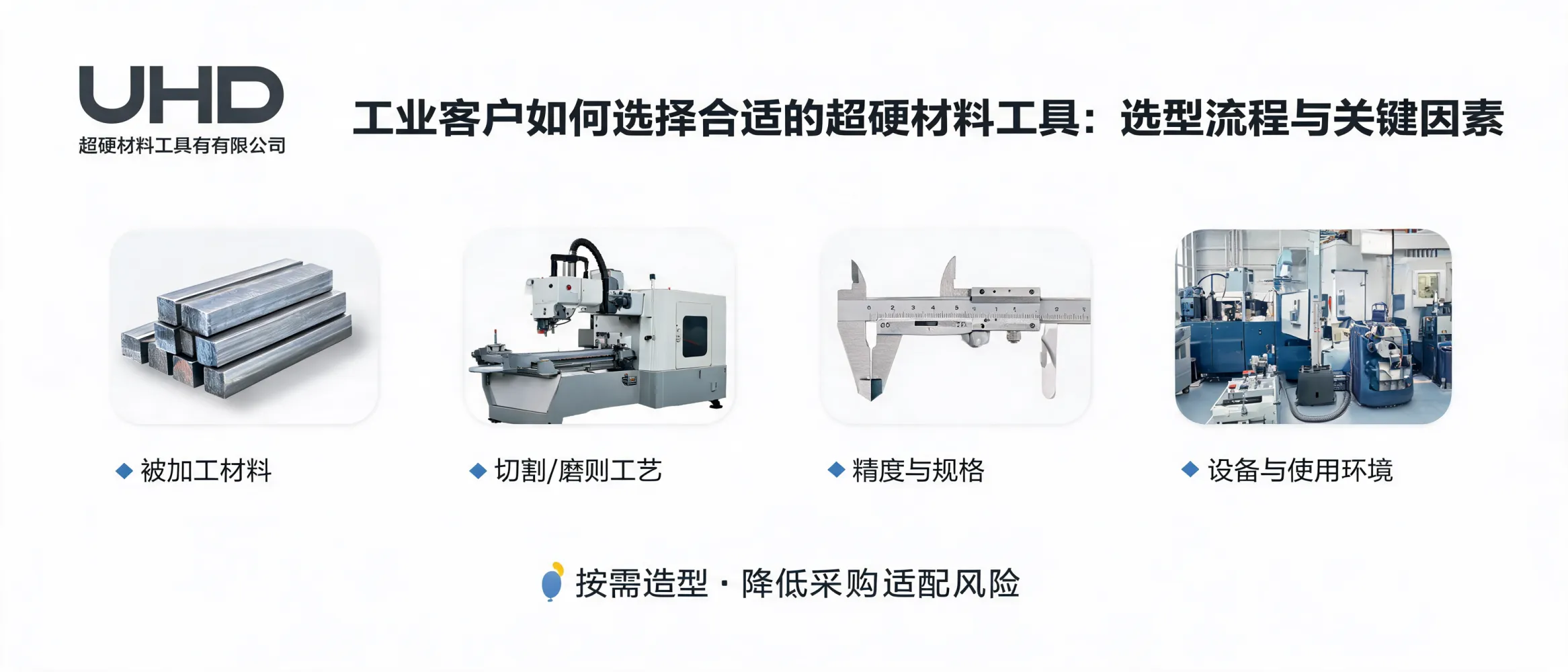
Start with a clear internal definition of your working conditions. Vacuum brazed diamond cutting tools can be designed differently depending on material, machine type, cooling method, and required finish. A well-defined requirement reduces misalignment and speeds up technical confirmation.
Evaluate whether the diamond abrasive selection matches your material and process. Consistent grit sizing and uniform distribution help stabilize cutting behavior and reduce variability across the tool edge.
Vacuum brazing quality is reflected in how well the diamond is bonded to the substrate. Strong, stable retention supports wear resistance and reduces premature grain pull-out during high-load cutting.
Procurement tip: ask the supplier to explain their brazing approach, substrate preparation, and how they control bond consistency from batch to batch.
Edge design affects cutting stability, heat generation, and chip evacuation. Confirm the intended edge profile, diamond exposure, and whether the design is optimized for your process (cutting vs. grinding vs. profiling).
Verify diameter/length, thickness, segment/working layer dimensions, bore/arbor or thread interface, and tolerances needed for your equipment. Poor fit can cause runout, vibration, and inconsistent results.
Industrial procurement should focus on stable performance under real operating conditions: steady cutting feel, predictable wear pattern, and controlled heat generation—especially for dry applications.
Consistency matters for production planning. Align on incoming inspection points, batch identification, and what will be considered acceptable variation for dimensions and cutting behavior.
Vacuum brazed tools are often sourced with application-specific needs. To avoid rework and delays, confirm customization items at RFQ stage and document them clearly.
Use the checklist below during supplier evaluation to ensure both sides discuss measurable criteria rather than general claims.
| Topic | Questions to ask | What to request |
|---|---|---|
| Diamond abrasive | What grit range and distribution are used for my material and process? | Abrasive specification and recommended application notes |
| Brazing quality | How is bond strength and retention consistency controlled? | Process overview + QC checkpoints relevant to brazing |
| Edge design | Which edge geometry is intended (cutting stability / chip removal / finish)? | Drawings, photos, or design description for approval |
| Dimensions & fit | What dimensions/tolerances ensure compatibility with my machines? | Dimension sheet and interface confirmation |
| Consistency | How are batches identified and what variation is considered normal? | Batch marking rule + incoming inspection suggestions |
| Customization | What inputs do you need to customize effectively and repeatably? | RFQ template, drawing format, sample policy |
Before placing a large order, validate samples under conditions that reflect your real production use. Keep the evaluation criteria consistent across suppliers to support fair comparison.
UHD Ultrahard Tools Co., Ltd (Henan UHD Ultrahard Tools) focuses on R&D, manufacturing, and sales of ultrahard material tools, providing B2B customers with application-oriented solutions for metal processing and stone processing. UHD’s portfolio includes diamond tools, abrasives, and custom vacuum brazed diamond abrasives, supported by an innovation-driven and quality-first approach.
UHD also maintains collaboration with universities such as Henan University of Technology, strengthening technical development and practical engineering communication—helpful for buyers who need clear specification alignment and repeatable production outcomes.
By structuring procurement around diamond abrasive quality, brazing bond strength, edge design, dimensions, wear resistance, and batch consistency, industrial buyers can make sourcing decisions that are more reliable and easier to scale. UHD supports technical clarification, customization alignment, and sample-based validation to help you evaluate vacuum brazed diamond cutting tools with confidence.
.png?x-oss-process=image/resize,h_1000,m_lfit/format,webp)


.png?x-oss-process=image/resize,h_1000,m_lfit/format,webp)