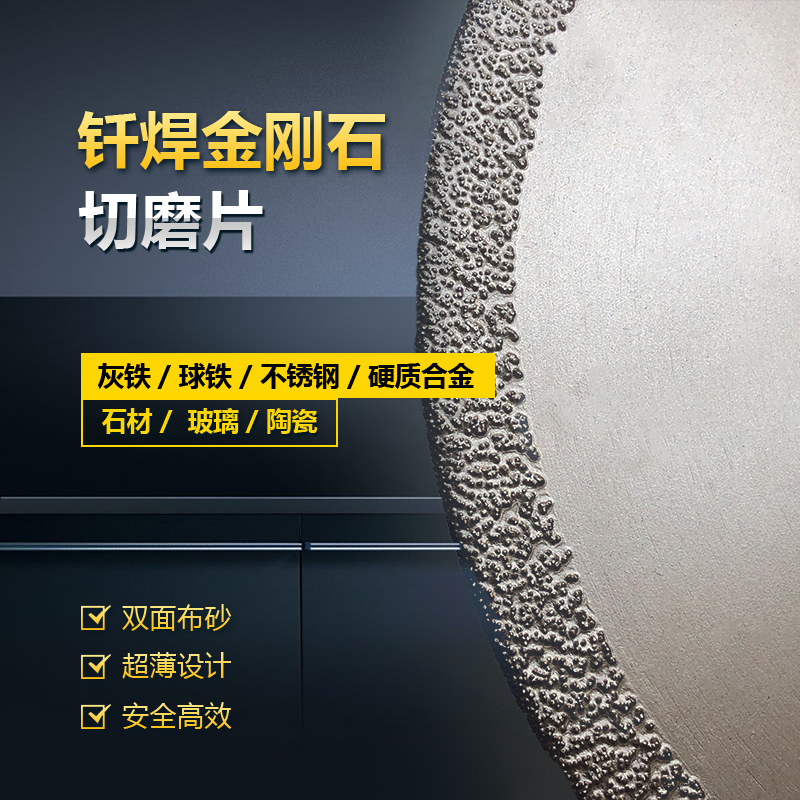
Vacuum brazed diamond cutting & grinding abrasives are industrial-grade diamond tools designed for dual-function cutting and grinding. They are commonly used when teams need fast material removal, stable cutting edges, and the ability to switch between operations without changing tools.
This page explains the definition and structure, performance characteristics, typical work materials, differences vs conventional abrasives, and selection basics—so procurement, engineering, and production teams can prepare practical specifications for evaluation and customization discussions with UHD Ultrahard Tools Co., Ltd (UHD).
Product focus
Vacuum brazed diamond cutting & grinding parts (diamond cut-and-grind discs)
HS Code
82079000
A vacuum brazed diamond cutting & grinding abrasive is a tool where diamond abrasive grains are fixed to a metal substrate through a brazing process. UHD’s dual-function design supports both cutting and grinding operations in one tool, helping operators adapt to changing shop-floor needs.
By combining cutting + grinding, a single disc can reduce tool changes during mixed operations (e.g., cut-to-length then edge conditioning). For industrial buyers, this often simplifies procurement and helps standardize tools across stations—depending on the equipment and process requirements.
One tool supports both operations for flexible workflows and improved operational efficiency in changing machining scenarios.
A thin design helps reduce material loss while aiming for clean, sharp cuts in suitable applications.
The high-manganese steel substrate provides strength and durability, supporting stable use under appropriate conditions and equipment settings.
Designed to handle a wide range of work materials (see the next section) for both metalworking and stone processing contexts.
UHD’s positioning is “quality builds the brand.” For B2B buyers, that means consistent manufacturing, measurable specifications, and professional pre-sales clarification—especially for diameter, bore, thickness, and compatibility with your equipment.
UHD vacuum brazed diamond cutting & grinding parts are positioned for industrial applications in metalworking and stone processing. Typical work materials include:
Note: suitability depends on the specific grade, disc geometry, equipment power/speed range, coolant/dry conditions, and the process target (cut quality vs removal rate).
| Aspect | Vacuum brazed diamond cutting & grinding parts | Conventional abrasives (general reference) |
|---|---|---|
| Working mechanism | Diamond grains act as cutting points for hard/brittle materials and demanding removal tasks. | Often relies on bonded abrasives (e.g., alumina/silicon carbide) suited for broader but different performance envelopes. |
| Process flexibility | Dual-function design supports cutting + grinding within one disc for many use cases. | Typically optimized for either cutting or grinding; tool changes may be more frequent in mixed processes. |
| Cut quality / kerf control | Thin-profile options can support clean cuts and lower material loss when properly matched. | Varies by abrasive type and bond; may require different specifications to reach similar cut cleanliness. |
| Tool selection focus | More emphasis on workpiece hardness, target finish, heat management, and equipment speed compatibility. | Often chosen primarily by grit/bond and general workpiece class; performance varies widely by formula. |
This comparison is for initial evaluation; final tool choice should be confirmed through your process requirements and the specific disc specification.
UHD can also supply multiple sizes; examples referenced in UHD’s measurements include Ø230 mm and Ø100 mm options (dimensions are measured from physical items and may vary by design).
UHD Ultrahard Tools Co., Ltd (UHD) is a high-tech enterprise focused on R&D, manufacturing, and sales of superhard material tools, serving industrial buyers in metalworking and stone processing. UHD emphasizes product-market fit—helping ensure each tool aligns with a specific process requirement.
If you are sourcing vacuum brazed diamond cutting & grinding abrasives for production use, share your work material, process target, equipment details, and preferred sizes. UHD’s team can help you clarify specifications and evaluate suitable options within the diamond cutting & grinding disc series.
Practical next step: Prepare a brief RFQ package including target material(s), operation (cut/grind), disc diameter & bore, machine RPM range, and whether you require thin-profile precision. UHD can then advise on fit and available configurations.


.png?x-oss-process=image/resize,h_1000,m_lfit/format,webp)
.png?x-oss-process=image/resize,h_1000,m_lfit/format,webp)