Stone Processing Application Case Study
Evaluating Cutting Efficiency and Process Stability with UHD Vacuum Brazed Diamond Abrasives
This page summarizes a typical stone machining scenario where manufacturers face low cutting efficiency, unstable results, and frequent tool wear. It explains how UHD Ultrahard Tools Co., Ltd (UHD) approaches abrasive selection and application with vacuum brazed diamond technology—so procurement and engineering teams can assess fit based on practical evaluation points.
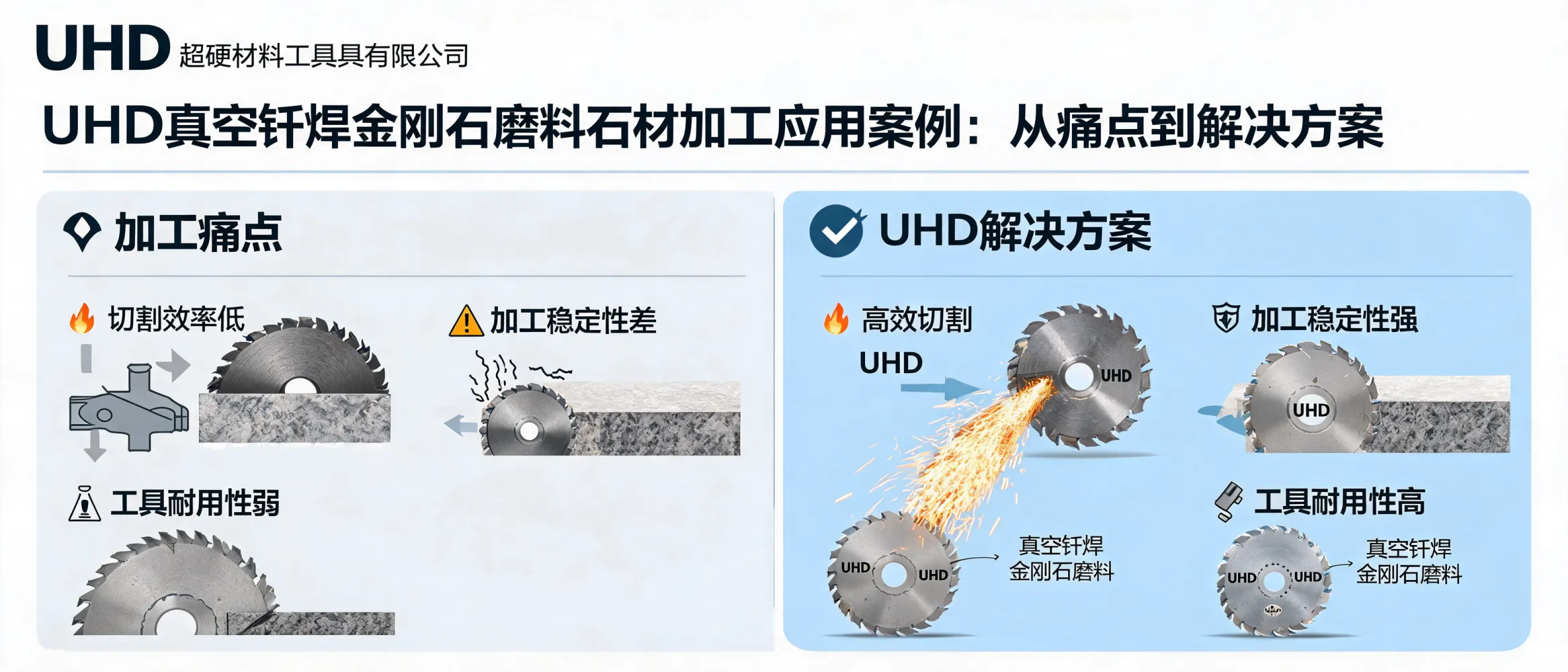
In stone machining, the same production line can show fluctuating output and inconsistent surface quality due to variations in material hardness, tool engagement conditions, and heat generation during cutting or grinding. When the abrasive structure and application parameters are not well matched, common symptoms include:
Practical takeaway: buyers should evaluate abrasives not only by “how fast it cuts” but also by process stability and durability under real operating conditions.
UHD’s case-study focus is the application of vacuum brazed diamond abrasives for stone processing. The intent is to help manufacturers improve:
Cutting Efficiency
Targeting higher effective material removal where existing tools slow down or glaze.
Process Stability
Reducing result fluctuation by selecting abrasive configuration aligned with the process.
Tool Durability
Extending usable life and lowering changeover frequency under appropriate conditions.
Note: Actual performance depends on stone type, machine rigidity, cooling method, feed/speed settings, and the selected abrasive specification.
For B2B buyers and process engineers, UHD recommends validating vacuum brazed diamond abrasives through structured checks. This supports transparent evaluation and repeatable procurement decisions.
UHD Ultrahard Tools Co., Ltd is a high-tech enterprise focused on R&D, manufacturing, and sales of ultrahard material tools. For stone processing applications, UHD’s support emphasizes matching the vacuum brazed diamond abrasive to the customer’s process conditions rather than relying on generic recommendations.
Confirm stone type, operation (cutting/grinding), equipment conditions, and target outcome.
Align abrasive configuration with efficiency and stability needs while considering durability expectations.
Provide practical guidance for implementation and evaluation criteria on the production line.
UHD also maintains collaborative R&D relationships with universities such as Henan University of Technology, supporting continued development and application understanding of ultrahard tooling.
Vacuum brazed diamond abrasives are commonly evaluated in scenarios where stable cutting/grinding performance is required across repeated cycles. Typical scenarios include:
Selection note: to compare suppliers fairly, keep the same machine, operator routine, and cooling method during trials, and record results consistently (cycle time, stability observations, and wear behavior).
To help UHD propose a suitable vacuum brazed diamond abrasive solution for stone processing, providing the following information improves matching accuracy:
Stone type and typical hardness/structure
Operation (cutting, edge grinding, surface grinding)
Machine type and spindle/power constraints
Cooling method and environmental conditions
Current pain points (wear, stability, efficiency)
Evaluation goals and acceptance criteria
UHD operates a B2B international service workflow and can support technical communication aligned with different market requirements.
UHD Ultrahard Tools Co., Ltd (UHD) focuses on the R&D, production, and sales of ultrahard material tools, including diamond tools, abrasives, and customized vacuum brazed diamond abrasive products. Guided by a quality-first philosophy, UHD aims to provide performance-oriented carbide and ultrahard tooling solutions for industrial buyers in metal and stone processing.
If you are assessing vacuum brazed diamond abrasives for stone machining, UHD can support specification matching and application evaluation to help you make a data-driven purchasing decision.


.png?x-oss-process=image/resize,h_1000,m_lfit/format,webp)