Applying Ultrahard Tools in Metal & Stone Processing: From Process Needs to Product Solutions
17 08,2026
UHD Ultrahard Tools Co., Ltd
Case Breakdown
UHD Ultrahard Tools Co., Ltd explains how ultrahard tools are selected for metalworking and stone processing—from material properties and machining challenges to matching diamond tools, abrasives, and vacuum brazed diamond abrasives for process-ready and custom product solutions.
In industrial production, ultrahard tool performance is determined less by “one-size-fits-all” product choices and more by a clear selection logic: start from material characteristics, confirm the dominant machining challenges, then match the process with the right category of diamond tools, abrasives, and vacuum brazed diamond abrasives.
As a high-tech enterprise focused on ultrahard material tools, UHD Ultrahard Tools Co., Ltd develops and supplies process-ready and customizable solutions for metalworking and stone processing, helping B2B buyers align tool structure, abrasive type, and bonding method with real production constraints.
A Practical Selection Logic (Material → Challenge → Tool Match)
- Define the workpiece material and its behavior: hardness, brittleness, thermal sensitivity, and whether it tends to clog or chip.
- Identify the key machining challenge: edge chipping, rapid wear, overheating, surface finish instability, vibration, or inconsistent stock removal.
- Choose the tool category: diamond tools for high-hardness/abrasive materials, abrasives for controlled finishing and stock removal, or vacuum brazed diamond abrasives for robust abrasive exposure and strong retention.
- Confirm process constraints: machine type, spindle power, coolant availability, speed/feed window, and required throughput.
- Finalize configuration: grit range, geometry, concentration/layout, and tool size—then validate by trial and feedback for stable mass production.
Where Ultrahard Tools Fit: Metalworking vs. Stone Processing
Metalworking: typical tool expectations
- Stable cutting/grinding behavior under heat and load
- Controlled wear to maintain dimensional consistency
- Process reliability across different production batches
Selection usually prioritizes thermal management, wear mode, and the balance between removal rate and finish.
Stone processing: typical tool expectations
- High resistance to abrasion from mineral content
- Reduced chipping and edge breakout on brittle substrates
- Consistent surface quality (from roughing to finishing)
Selection typically emphasizes chip control, shock resistance, and stable abrasive exposure during long runs.
Tool Families UHD Works With (and How to Think About Them)
| Tool category |
Best used when |
Key selection variables |
|
Diamond tools
For cutting/grinding of hard, abrasive materials
|
When you need strong wear resistance and stable stock removal across demanding workpieces and long cycles.
|
Grit range, segment/working layer design, tool geometry, coolant condition, machine power and rigidity.
|
|
Abrasives & grinding products
For controlled material removal and finishing
|
When surface quality, repeatability, and process stability are priorities—especially for step-by-step finishing.
|
Abrasive type, grit size progression, hardness/grade, backing/body compatibility, and target roughness.
|
|
Vacuum brazed diamond abrasives
For strong grain retention and aggressive exposure
|
When you need robust abrasive retention and a tool form that can be tailored for specific contact areas or profiles.
|
Diamond layout/distribution, working surface pattern, tool body material, geometry, and process temperature/load.
|
Note: exact parameters depend on your workpiece, equipment, and production targets. UHD supports selection based on application details rather than generic assumptions.
Custom Tool Configuration: What Can Be Adapted
Geometry & fit
- Tool dimensions and mounting interfaces
- Profile shapes for edge, slot, or contour work
- Working area design for consistent contact
Abrasive structure
- Grit selection for roughing vs. finishing
- Abrasive distribution/layout to control cutting action
- Layer/segment design based on wear behavior
Process compatibility
- Dry vs. wet operation considerations
- Speed/feed window and heat management
- Stability under vibration and intermittent contact
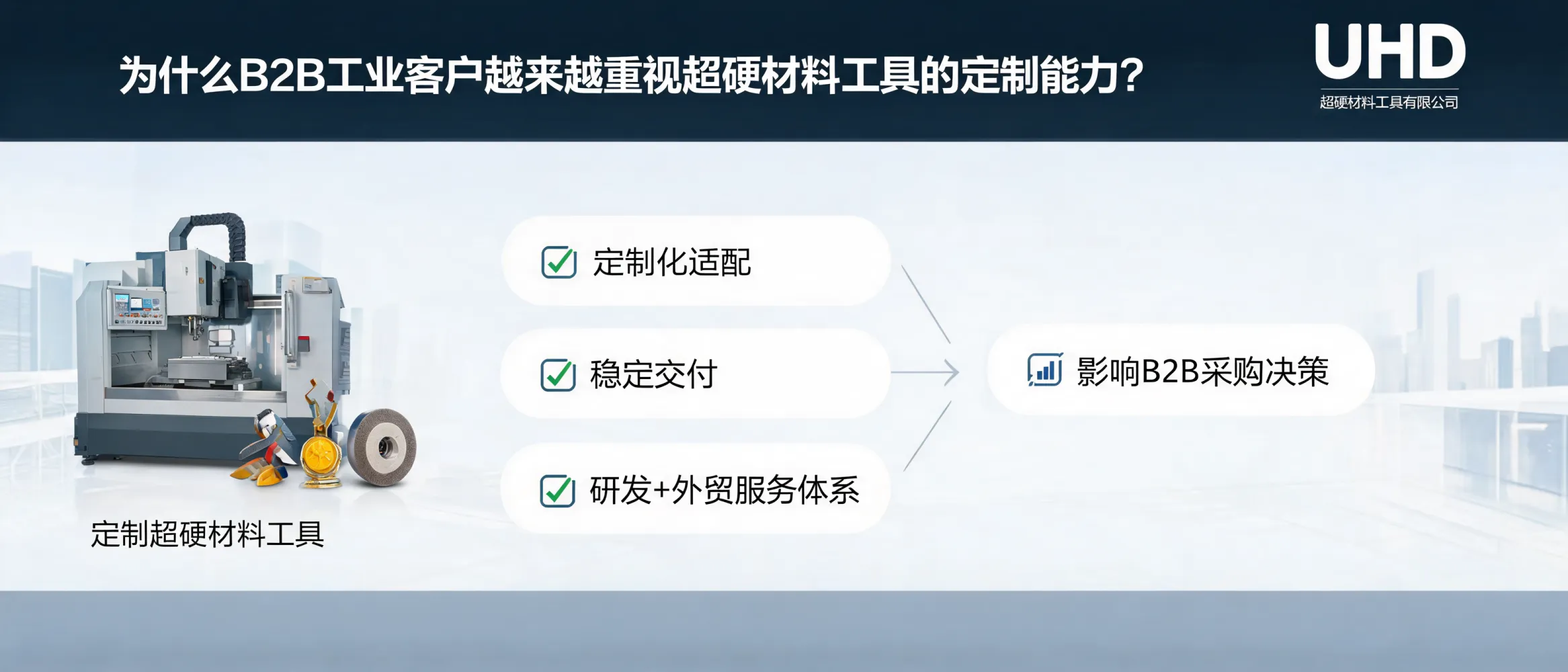
Why customization matters: In metalworking and stone processing, the same base tool type can behave very differently depending on machine rigidity, coolant condition, and the material’s wear/chipping mechanism. Matching configuration to process is often the difference between unstable trials and repeatable production.
Information UHD Typically Needs for Application Matching
- Workpiece: material type, hardness/grade (if known), and whether it is prone to chipping or clogging
- Process: cutting/grinding/finishing step, target surface quality, and tolerance focus
- Machine: equipment type, spindle power, speed range, fixture condition
- Operating mode: dry or wet, coolant type/flow (if any), cycle time and shift plan
- Current tool feedback: wear pattern, failure mode, and the most urgent improvement goal
With these inputs, UHD can align tool structure and abrasive choice to your production reality—supporting stable performance and improved tool value without relying on unsupported claims.
UHD Capability Snapshot (R&D + B2B Delivery)
R&D-driven tool development
UHD invests in ultrahard tool research and works with academic partners such as Henan University of Technology to support ongoing development of ultrahard material tooling—aiming for reliable, application-based solutions in metal and stone processing.
Global B2B support
With a structured foreign trade service system and communication via major B2B channels, UHD supports industrial buyers with product selection, specification alignment, and supply coordination for different market needs.
Brand principle: Quality builds the brand. UHD focuses on delivering comprehensive ultrahard tooling solutions—matching product design to process requirements for long-term, stable cooperation.
Discuss Your Application
If you are selecting ultrahard tools for metalworking or stone processing, UHD can help you confirm the selection path—from material properties and machining challenges to a suitable combination of diamond tools, abrasives, and vacuum brazed diamond abrasives.
Share your workpiece, machine model, operating mode (dry/wet), and current tool issues, and we will align a product configuration that fits your process and procurement requirements.


.png?x-oss-process=image/resize,h_1000,m_lfit/format,webp)

.png?x-oss-process=image/resize,h_1000,m_lfit/format,webp)