Selecting Ultrahard Material Tools: A Practical Guide for Industrial Working Conditions, Tool Life, and Efficiency
07 07,2026
UHD Ultrahard Tools Co., Ltd
Industry Guide
UHD Ultrahard Tools Co., Ltd explains how industrial buyers and engineers can select ultrahard material tools based on real working conditions—material type, cutting/grinding requirements, expected tool life, and machining efficiency—providing actionable criteria for procurement and technical evaluation.

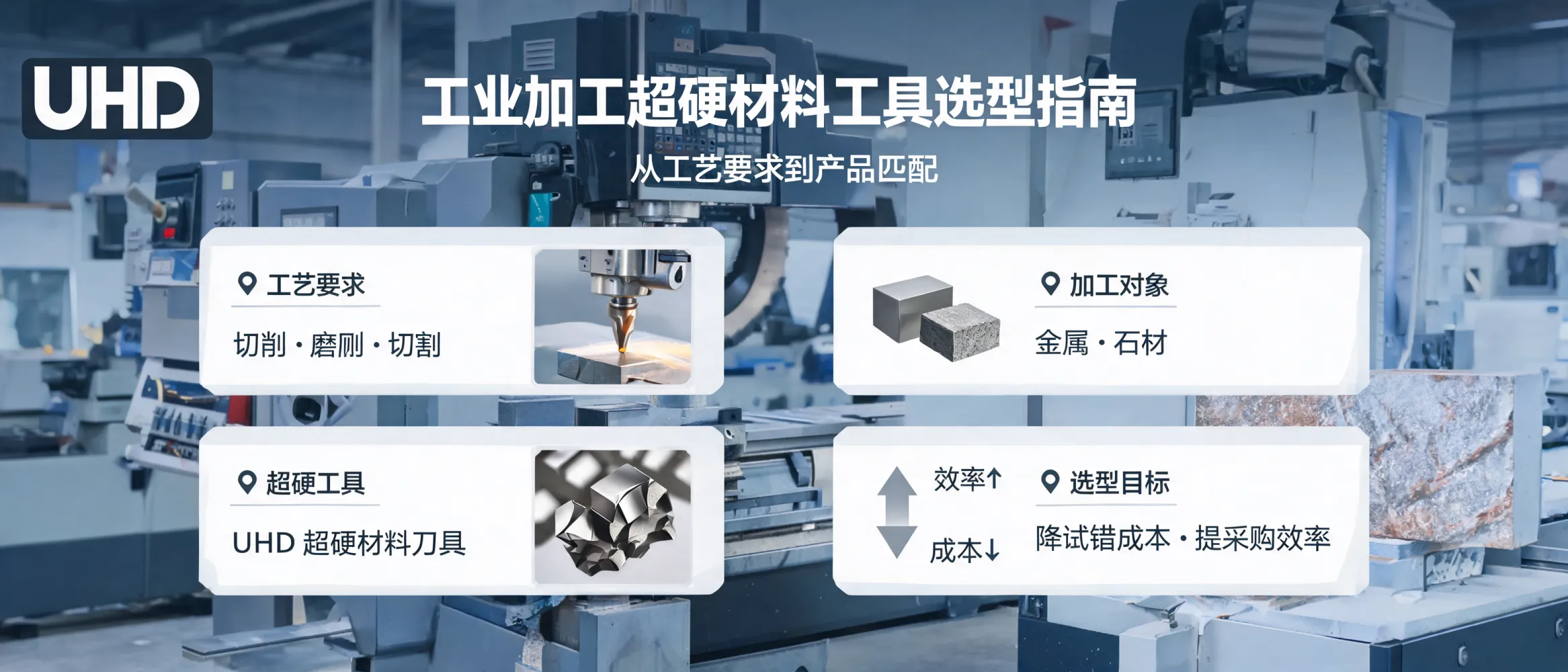
Industrial tool selection is most reliable when it starts from real working conditions—not from a generic catalog. This guide from UHD Ultrahard Tools Co., Ltd explains how buyers and process engineers can evaluate ultrahard material tools using measurable criteria tied to tool life and machining efficiency in metal and stone processing.
Working conditions first
Tool life targets
Machining efficiency
Procurement + technical evaluation
1) Define the working conditions (the non-negotiable inputs)
Before comparing tool grades or price points, document the operating environment. These inputs determine the appropriate ultrahard tool type and the performance indicators you should prioritize.
Working-condition checklist
- Workpiece material: metal type/condition or stone type; note hardness, abrasiveness, and inclusions.
- Operation type: cutting, grinding, shaping, deburring, polishing, or mixed operations.
- Contact mode: continuous vs. intermittent cutting/grinding; impact and vibration level.
- Heat and cooling: dry vs. wet process, coolant availability, heat sensitivity of the workpiece.
- Machine constraints: spindle power, RPM range, rigidity, feed control, fixture stability.
- Quality requirements: surface finish targets, dimensional tolerance, chipping/burr limits.
2) Map the operation to an ultrahard tool solution
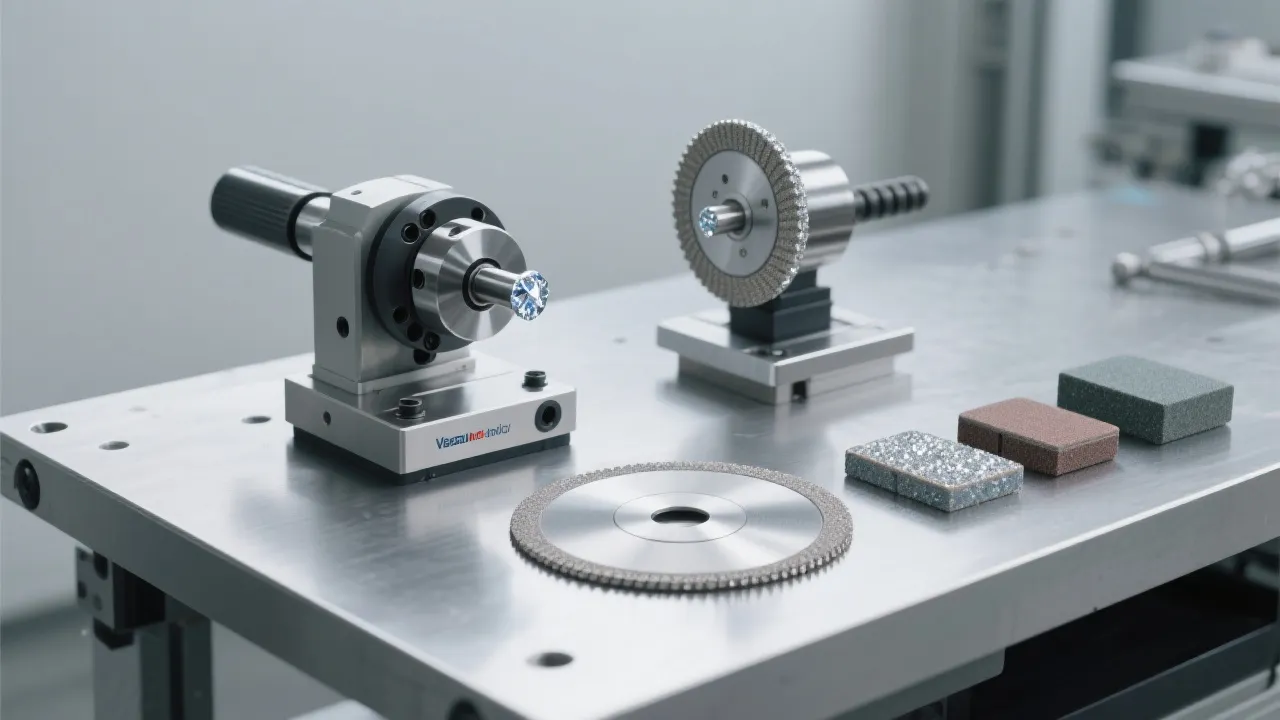
UHD focuses on ultrahard material tooling such as diamond tools, abrasives, and custom brazed diamond abrasives. Selection should align tool structure with the removal mechanism needed (cutting vs. grinding) and the expected wear mode.
| Selection step |
What to confirm |
Why it matters |
Typical output for evaluation |
| Material fit |
Hardness/abrasiveness, thermal behavior, and sensitivity to cracking |
Determines wear rate, heat generation, and risk of edge damage |
Shortlist of ultrahard tool types/structures to trial |
| Process match |
Cutting vs. grinding, continuous vs. intermittent contact |
Impacts tool stability and chipping resistance requirements |
Trial plan: operating window and pass strategy |
| Tool construction |
Abrasive type, bonding/brazing approach, geometry, and safety margins |
Controls retention of abrasive, heat resistance, and service life |
Specification sheet for procurement & QC checks |
| Outcome metrics |
Tool life target and efficiency target (per part / per meter / per shift) |
Ensures selection supports production goals, not only unit price |
Acceptance criteria for trials and scale-up decision |
Practical tip: If the process has high vibration or intermittent contact, prioritize stability and edge integrity over aggressive removal rate, then optimize parameters to recover machining efficiency.
3) Evaluate by performance indicators tied to tool life and efficiency
To compare candidate ultrahard material tools fairly, use consistent indicators that can be observed during trials and recorded for procurement decisions.
Tool life (durability-focused)
- Wear resistance: rate of abrasive/edge degradation under the same parameters
- Retention & integrity: resistance to grain pull-out, segment loss, or abnormal breakage
- Thermal resistance: stability under heat buildup (especially in dry or high-load operations)
- Consistency: variance between tools/batches under identical test conditions
Machining efficiency (throughput-focused)
- Material removal behavior: stable cutting/grinding without excessive force spikes
- Surface outcome: meets finish requirements with fewer passes or reduced rework
- Process window: tolerance to parameter changes without rapid wear or quality loss
- Downtime impact: frequency of dressing, replacement, or adjustment
Make indicators measurable
Define how you will measure tool life (e.g., per piece, per meter, per hour) and efficiency (cycle time, pass count, rework rate) before trials begin. This avoids “good/bad” judgments and supports transparent supplier comparison.
4) Build a procurement and trial plan that engineers can approve
A selection decision is easier to defend internally when procurement and engineering share the same test plan. UHD typically supports customers with a technical communication approach aligned to B2B purchasing workflows.
- Define the baseline: current tool specification, parameters, output rate, and failure mode (wear, chipping, burning, poor finish).
- Set acceptance criteria: minimum tool life and minimum machining efficiency improvement expectations (use your plant’s own targets).
- Control variables: keep machine, operator method, coolant, and workpiece batch as consistent as possible.
- Run staged trials: start conservative, expand to a safe operating window, then optimize feed/speed for throughput.
- Record results: tool wear state, number of passes, finish status, stoppages, and any abnormal events.
- Decide and standardize: confirm specification, inspection points, and reorder parameters for stable production.
5) Common selection mistakes to avoid
- Choosing by name only: “diamond tool” can mean very different constructions and performance boundaries.
- Ignoring working-condition extremes: intermittent contact, poor rigidity, or dry heat can dominate failure modes.
- Over-optimizing for unit price: total cost often depends on tool change frequency, scrap/rework, and downtime.
- Uncontrolled trials: parameter changes during testing make results non-comparable and hard to approve.
About UHD Ultrahard Tools Co., Ltd
UHD Ultrahard Tools Co., Ltd (Henan UHD Ultrahard Tools) is a high-tech enterprise specializing in the R&D, manufacturing, and sales of ultrahard material tools. Our portfolio includes diamond tools, abrasives, and custom brazed diamond abrasives for industrial applications such as metal and stone processing. We collaborate with academic partners (including Henan University of Technology) to support product development and application-oriented evaluation.
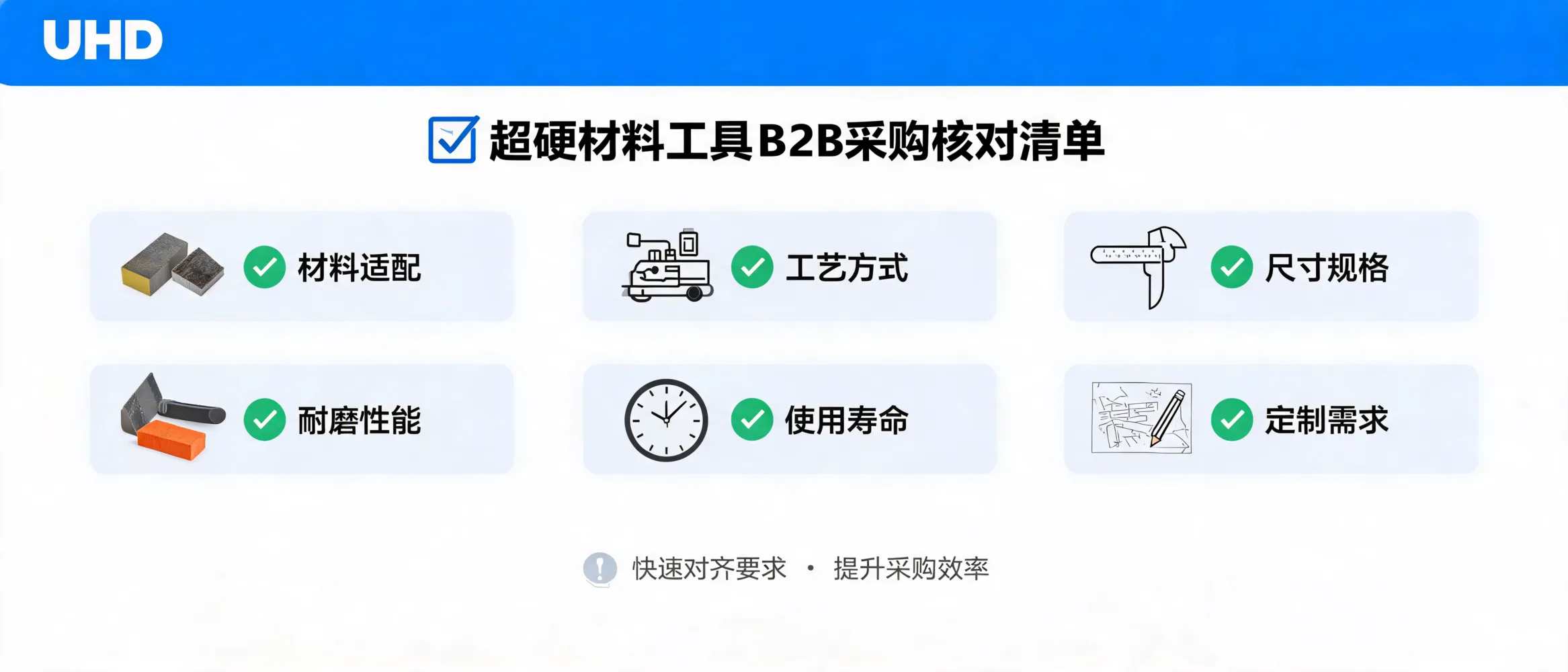
What to prepare when contacting us for selection support
Workpiece material & photos (optional)
Operation type (cut/grind) & current tool
Machine model, RPM/power, coolant
Tool life baseline & efficiency target
Quality requirements (finish/tolerance)
With these inputs, teams can align faster on a trial plan and evaluate candidates against the same tool life and machining efficiency criteria.
Use this guide as a repeatable selection standard
When selecting ultrahard material tools, start from working conditions, evaluate stability and wear behavior, then confirm targets for tool life and machining efficiency with a controlled trial plan. This creates a practical, auditable path from technical evaluation to procurement approval—especially for industrial B2B sourcing.

.png?x-oss-process=image/resize,h_1000,m_lfit/format,webp)
.png?x-oss-process=image/resize,h_1000,m_lfit/format,webp)