In industrial machining and fabrication, ultrahard tools (including diamond tools and brazed diamond abrasives) are often evaluated under time pressure—yet the wrong selection can quietly increase total machining cost through rework, unstable quality, and downtime. This page summarizes six common procurement mistakes and a practical validation checklist to help procurement, engineering, and production teams reduce selection risk.
Context: UHD Ultrahard Tools Co., Ltd (UHD) develops and manufactures ultrahard material tools for industrial applications, including diamond tools, abrasives, and customized vacuum-brazed diamond products. The guidance below focuses on how to evaluate and validate tools and suppliers—not on chasing the lowest unit price.
Ultrahard tools are not interchangeable commodities. Tool performance depends on a system of variables: workpiece material, machining parameters, machine rigidity, coolant/dry conditions, and the required surface/geometry. A lower unit price can be offset by shorter life, lower throughput, higher scrap, or frequent dressing/adjustment—ultimately raising total cost per part.
Unit price is only one line item. What matters is cost per usable output (e.g., parts per tool, meters cut per wheel) and the risks around stability and scrap.
“Similar” materials can behave very differently. Variations in hardness, porosity, reinforcement, grain size, coatings, or heat treatment can change wear mechanisms and tool loading.
Even a well-designed diamond tool can underperform if the spindle power, RPM range, runout control, fixturing, or vibration profile does not match the process window.
A single parameter (e.g., grit size, concentration, bond type, or a headline hardness number) rarely predicts real performance by itself. Outcomes depend on how multiple elements interact under your specific conditions.
A successful sample run can be misleading if parameters, operators, or measurement methods are not controlled. Without a test plan, comparisons become subjective and results are hard to reproduce.
Ultrahard tooling is application-driven. When issues occur—chipping, glazing, burning, unexpected wear—fast diagnosis and practical parameter guidance can be more valuable than a small unit-price difference.
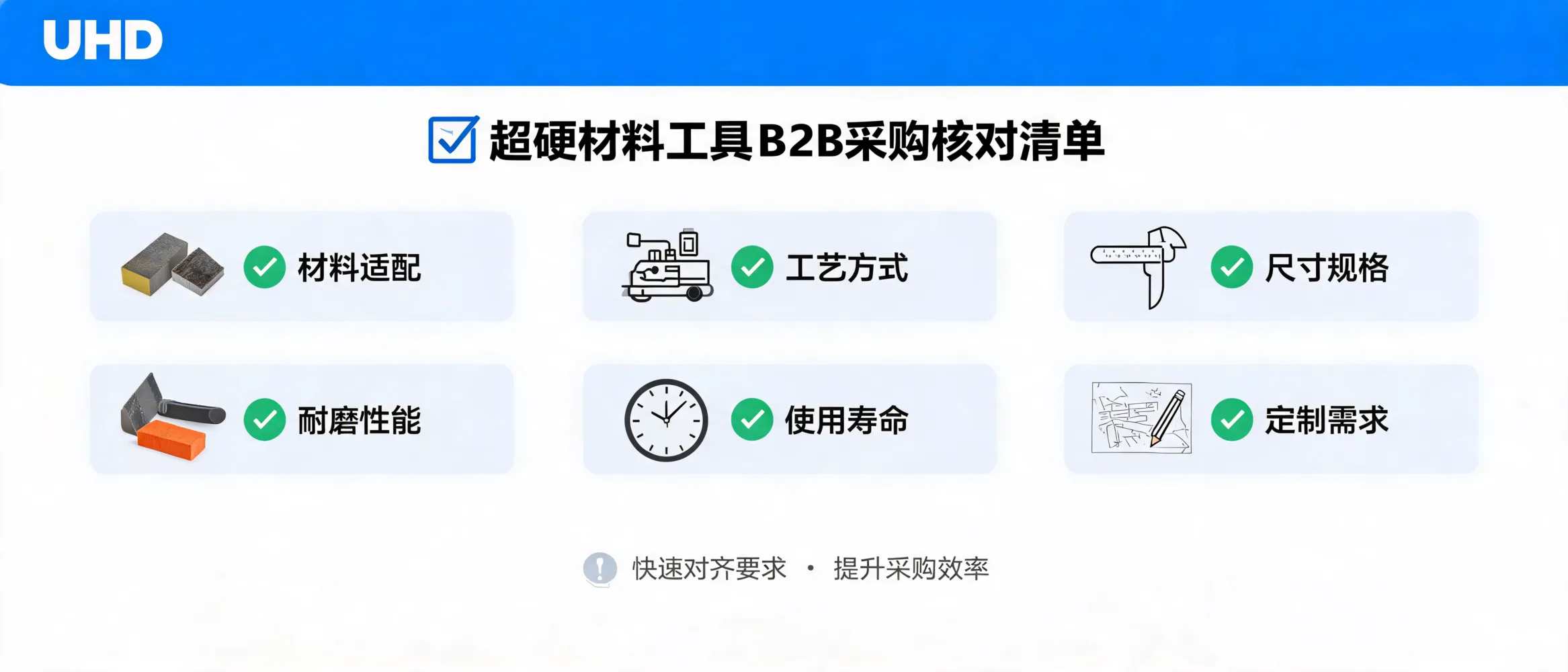
Use this checklist to structure supplier evaluation, sample testing, and controlled batch rollout. It is designed to improve decision quality and help control total machining cost.
| Stage | What to Confirm | Evidence / Output |
|---|---|---|
| Requirements | Workpiece spec, target quality, process route, key constraints (cycle time, finish, edge quality, noise/vibration limits), wet/dry and coolant conditions. | A clear application brief; agreed KPIs for evaluation (life/throughput/quality). |
| Compatibility | Machine interface, RPM range, power, runout control, fixture rigidity, safety limits, and tool dimensions. | Fit confirmation and parameter window proposal. |
| Sample Test | Controlled comparison with baseline tool: same conditions, defined measurements, consistent inspection criteria. | Test report: wear mode notes, output per tool, scrap/rework observations, parameter adjustments. |
| Batch Rollout | Introduce in a controlled batch; monitor stability across operators/shifts and material lots. | Go/no-go decision based on repeatability and total machining cost impact. |
| Ongoing Support | Technical communication, corrective actions, and continuous optimization when materials or conditions change. | Documented feedback loop; updated parameters and tool configuration when needed. |
Procurement tip: When requesting quotations, align all suppliers to the same application brief and acceptance criteria. This prevents “spec mismatch” quotes that look cheaper but don’t meet your real operating conditions.
UHD Ultrahard Tools Co., Ltd focuses on R&D, manufacturing, and B2B supply of ultrahard material tools. In sourcing and validation, UHD can support teams by aligning tool selection with real process constraints and by enabling structured testing prior to wider rollout.
Confirming workpiece details, process route, and acceptance criteria so the recommended diamond tool or abrasive configuration matches your actual objectives.
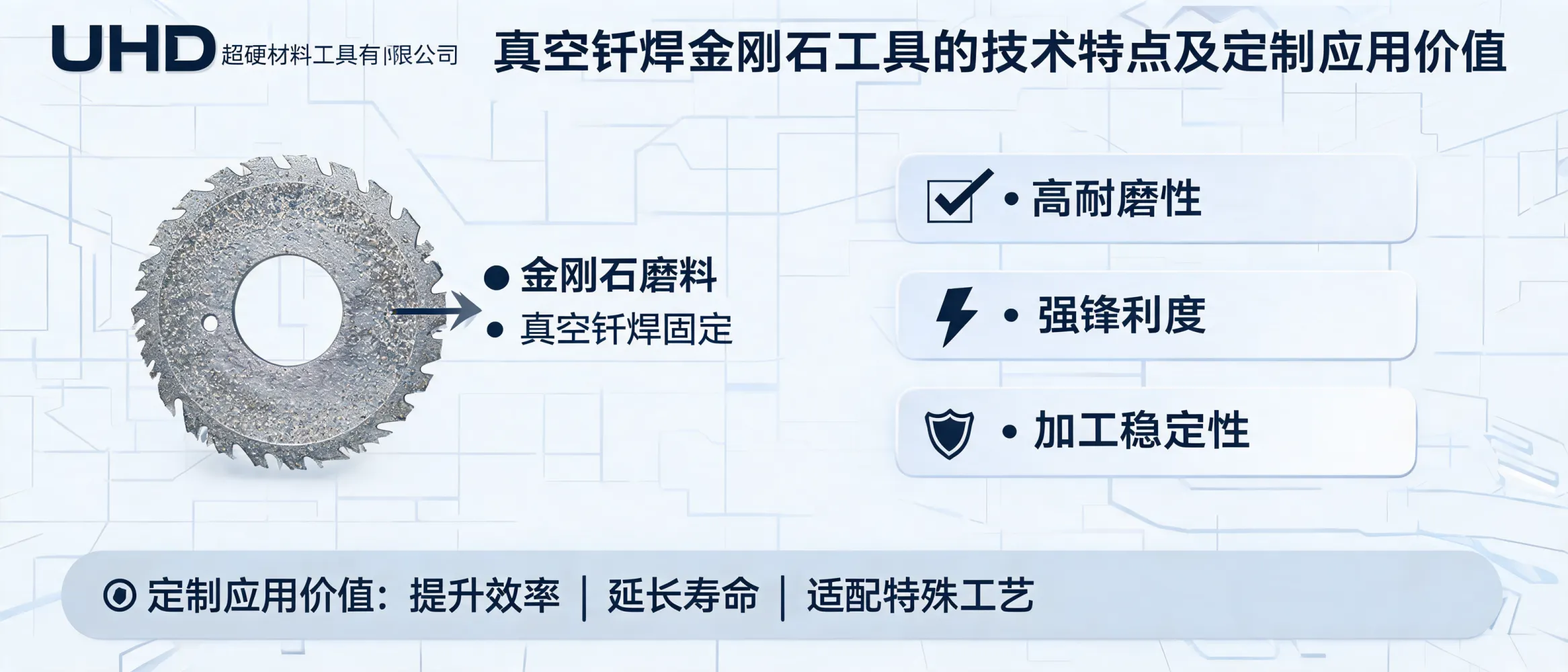
For non-standard conditions, UHD offers support for customized ultrahard tool solutions such as vacuum-brazed diamond products, guided by machine and process constraints.
Clear communication for international buyers, with structured coordination across procurement, engineering, and production to support sample testing and controlled batch introduction.
If you are sourcing ultrahard tools and want a selection process that prioritizes stability and total machining cost control, prepare your workpiece specs, machine details, and target KPIs, then align on a test-and-rollout plan.
UHD Ultrahard Tools Co., Ltd can then support a structured evaluation approach—helping procurement and technical teams make decisions based on validated performance rather than unit price alone.

.png?x-oss-process=image/resize,h_1000,m_lfit/format,webp)


.png?x-oss-process=image/resize,h_1000,m_lfit/format,webp)