Precision Grinding: A Systematic Guide to Selecting Brazed Diamond Tools for Stable Machining
04 10,2026
UHD Ultrahard Tools Co., Ltd
Technical Articles
UHD Ultrahard Tools explains a systematic approach to selecting and validating brazed diamond tools for precision grinding—linking workpiece properties, process requirements, machine conditions, grit retention, heat/chip control, and stability, with insights from UHD SupraCut capabilities.

Precision grinding outcomes depend heavily on whether a brazed diamond tool is matched to the workpiece, process targets, and machine conditions—and then verified before scaling production. This page provides a practical, systematic selection framework aligned with stable machining requirements, and references the capabilities of UHD Ultrahard Tools and the UHD SupraCut brazed diamond tool range (customizable) without assuming fixed performance values.
Scope: selection and verification for brazed diamond tools used in precision grinding—focusing on grit retention, heat/chip control, structure & brazing integrity, and machining stability for metalworking and stone processing.
1) Start with the workpiece: hardness, brittleness, and grindability
Before choosing any tool specification, define the workpiece behavior under grinding. For brazed diamond tools, the workpiece determines how aggressively the diamonds should cut, how chips form, and how much heat is generated.
- Hardness & abrasiveness: influences diamond wear mode and the need for robust grit retention in the brazed layer.
- Brittleness (e.g., chipping tendency): affects preferred cutting action and edge preparation to reduce micro-chipping.
- Thermal sensitivity: guides heat dissipation requirements and coolant strategy to maintain process stability.
2) Define the process method and target outputs
Precision grinding is not one single process. Clarify the grinding method and your quality targets, then translate them into tool requirements.
Method
- Surface / profile grinding
- Tool & cutter grinding
- Stone/ceramic edge processing
Targets
- Accuracy and dimensional stability
- Surface finish requirement
- Consistency across batches
These definitions set the baseline for selecting abrasive layout, tool body structure, and heat/chip evacuation features—key drivers of stable machining.
3) Check the machine conditions that impact stability
A brazed diamond tool can only perform as steadily as the machine system allows. Stability issues are often rooted in machine constraints rather than the abrasive alone.
- Spindle power & rigidity: affects allowable cutting forces and vibration sensitivity.
- Runout & balancing: influences contact uniformity, wear distribution, and surface quality.
- Coolant delivery and filtration: impacts heat dissipation, chip evacuation, and re-cut risk.
- Workholding and part stiffness: determines susceptibility to chatter and shape deviation.
Practical tip: If you see unstable marks, burn, or premature grit loss, validate runout, coolant direction/flow, and dressing/conditioning approach (if applicable) before changing multiple tool parameters at once.
4) Understand grit retention and brazing integrity (what to look for)
In brazed diamond tools, grit retention is governed by the brazing layer and bonding quality. Retention directly affects cutting consistency and tool life expectation in precision grinding.
| Evaluation factor |
Why it matters for stable machining |
What to verify (examples) |
| Abrasive layout |
Controls chip space, contact behavior, and cutting uniformity. |
Grit distribution consistency; adequate chip pockets for your operation. |
| Tool body structure |
Affects stiffness, vibration resistance, and thermal path. |
Runout control; balance condition; interface fit (bore/flange). |
| Brazing integrity |
Determines grit retention and resistance to sudden grit pull-out. |
Uniform brazed layer; absence of weak bonding zones; stable edge condition. |
| Quality inspection consistency |
Reduces lot-to-lot variation and supports predictable process windows. |
Incoming/outgoing checks aligned to your drawing and application conditions. |
5) Heat dissipation and chip evacuation: preventing instability
Precision grinding stability is often limited by heat and chip re-cutting. With brazed diamond tools, ensure the tool design and process setup help remove chips and keep temperatures controlled.
- Chip space: adequate spacing reduces clogging and improves surface consistency.
- Coolant access: coolant should reach the contact zone effectively (direction and pressure matter).
- Process parameters: feed/speed choices should be validated with a controlled trial plan.
6) A practical selection & verification workflow (B2B-ready)
Use the following workflow to reduce uncertainty when selecting a brazed diamond tool for precision grinding:
- Collect application inputs: workpiece material, hardness/brittleness behavior, drawing tolerances, surface finish target, and grinding method.
- Confirm machine constraints: spindle capability, runout, rigidity, coolant type and delivery, and workholding.
- Select tool structure & abrasive layout: choose geometry and layout that support chip evacuation and stability for your contact conditions.
- Plan validation trials: define measurable checks (surface finish, dimensional drift, wear pattern observation) and keep parameter changes controlled.
- Lock the spec + inspection points: after validation, confirm the tool drawing/spec and the inspection checkpoints needed for consistent supply.
Information UHD typically reviews for customization
Workpiece & goal
Material type, feature geometry, tolerance/finish target, expected stability priorities.
Process & machine
Grinding method, spindle conditions, coolant approach, fixture and contact mode.
Tool interface
Mounting type, dimensions, balance/runout expectations, inspection preferences.
UHD SupraCut: brazed diamond tooling designed for controlled consistency
UHD SupraCut brazed diamond tools are developed for industrial users who need high-hardness cutting/grinding capability with an emphasis on process stability and reliable supply. UHD Ultrahard Tools applies a structured approach covering tool design, brazing integrity, and quality control to help customers validate tooling for their specific precision grinding conditions.
- Ultra-precision brazing approach: aimed at improving durability and stability under controlled conditions.
- Superhard material utilization: supports high hardness and abrasion resistance for demanding applications.
- Quality control inspection: helps maintain consistent tool quality across deliveries.
- Customization service: matches tooling to specific process requirements and interfaces.
- R&D collaboration: ongoing development supported by cooperation with universities (e.g., Henan University of Technology).
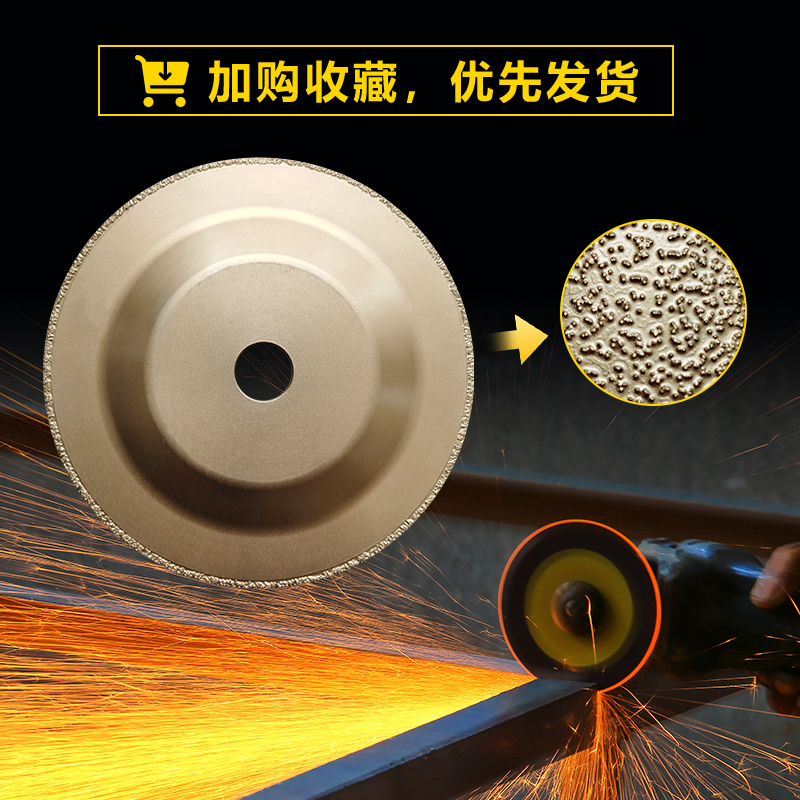
Product reference image: UHD SupraCut brazed diamond tool (example). Final geometry and abrasive layout can be customized based on application inputs.
When brazed diamond tools are a good fit (and when to reassess)
Often suitable for
- High-hardness materials requiring diamond abrasives
- Applications sensitive to stability and cutting consistency
- Metalworking and stone processing needing custom tooling interfaces
Reassess if
- Machine runout or rigidity cannot support the required stability
- Coolant delivery cannot reach the grinding zone effectively
- Chip evacuation space is insufficient for your contact mode
Next step: align on a tool spec you can validate
For B2B sourcing and engineering validation, the most efficient path is to align on a tool drawing/specification and a trial plan that reflects your real machine conditions. UHD Ultrahard Tools supports global buyers through established international trade channels and can provide custom brazed diamond tools under consistent inspection requirements.
To evaluate UHD SupraCut for your precision grinding task, prepare: workpiece material + target tolerances/finish, grinding method, machine model/spindle details, coolant approach, and any constraints on runout/balance or tool interface.


.png?x-oss-process=image/resize,h_1000,m_lfit/format,webp)