In industrial sourcing, ultrahard material tools (including many types of diamond tools) are rarely “one-price-fits-all.” Even when tools look similar on paper, differences in workpiece material, machine conditions, and process parameters can change real performance and total cost dramatically.
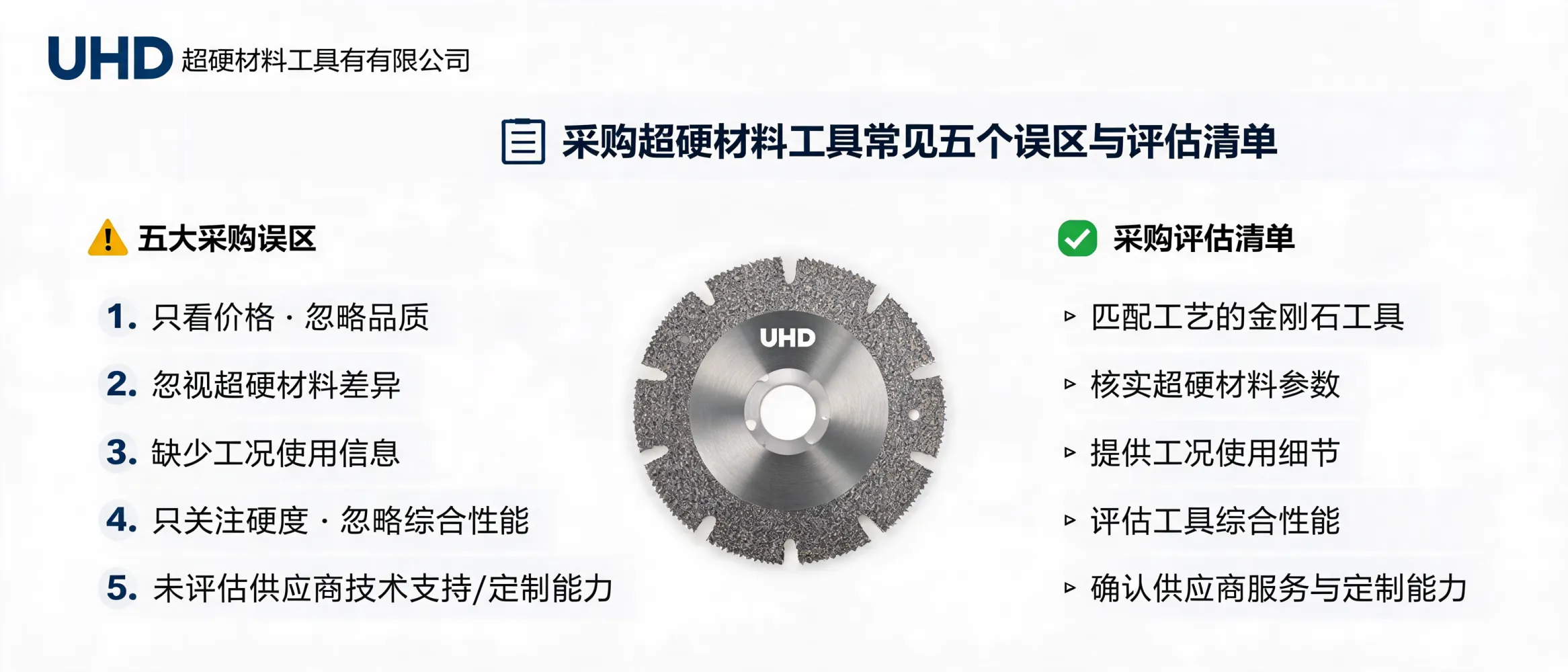
Drawing from UHD Ultrahard Tools Co., Ltd’s experience in R&D and B2B supply of superhard tooling, this page summarizes five common purchasing mistakes beyond unit price and provides a practical checklist to help buyers evaluate tool–process matching, quality fit, and supplier support.
Unit price is easy to compare; cost per finished part or per meter is what matters. A lower-priced tool may cost more through shorter life, unstable cutting/grinding behavior, extra dressing/rework, or increased scrap.
“What is the expected tool life and production stability under my parameters, and how does that translate into cost per output (including changeover time and quality losses)?”
“Same category” workpieces can behave very differently. In metal and stone processing, variations in composition, hardness distribution, inclusions, porosity, surface coatings, or heat treatment can require a different tool configuration to maintain consistency.
Ultrahard tooling performance is highly sensitive to operating conditions. If the supplier receives incomplete information, recommendations may be technically correct in general—but wrong for your line.
| Condition category | Examples buyers should specify | Why it matters |
|---|---|---|
| Machine & setup | Spindle power, rigidity, runout, fixture/clamping | Affects vibration, edge stability, and wear pattern |
| Parameters | Speed/feed, depth of cut, step-over, contact pressure | Determines heat, loading, and productivity balance |
| Cooling & environment | Wet/dry, coolant type, flow, dust management | Impacts thermal shock, clogging, and surface quality |
| Quality target | Roughness/flatness goals, chip control needs, burn marks limits | Guides selection between aggressiveness vs. finish stability |
Practical tip: provide your current tool pain points (e.g., chipping, glazing/loading, burn marks, inconsistent life). These symptoms often help identify the mismatch faster than specs alone.
In ultrahard tools, “harder” does not automatically mean “better.” Tool value is a combination of wear resistance, toughness, thermal behavior, bonding/structure suitability, and how the tool behaves under your specific process window.
Selecting a tool mainly because its datasheet highlights “highest hardness” can lead to brittle behavior, unexpected chipping, or unstable finishes—especially when impact, vibration, or interrupted contact is present.
For industrial buyers, a tool is not just a SKU—it is part of a process. When parameters change or a new workpiece is introduced, you may need faster iteration, application guidance, and tailored configurations (for example, custom designs for specific operations).
Use the checklist below to build an internal, repeatable decision process for ultrahard material tools purchasing—especially when comparing quotations from multiple suppliers.
UHD Ultrahard Tools Co., Ltd focuses on R&D, manufacturing, and B2B supply of superhard tooling solutions, including diamond tools, abrasives, and custom brazed diamond abrasive products. We work closely with industrial customers to clarify operating conditions and align tools with real process requirements—helping procurement and engineering teams make more reliable sourcing decisions.
If you are reviewing tool options, prepare your workpiece details and operating parameters first—then communicate them consistently across suppliers. This simple step removes most uncertainty and makes technical comparison far more objective.
.png?x-oss-process=image/resize,h_1000,m_lfit/format,webp)


.png?x-oss-process=image/resize,h_1000,m_lfit/format,webp)