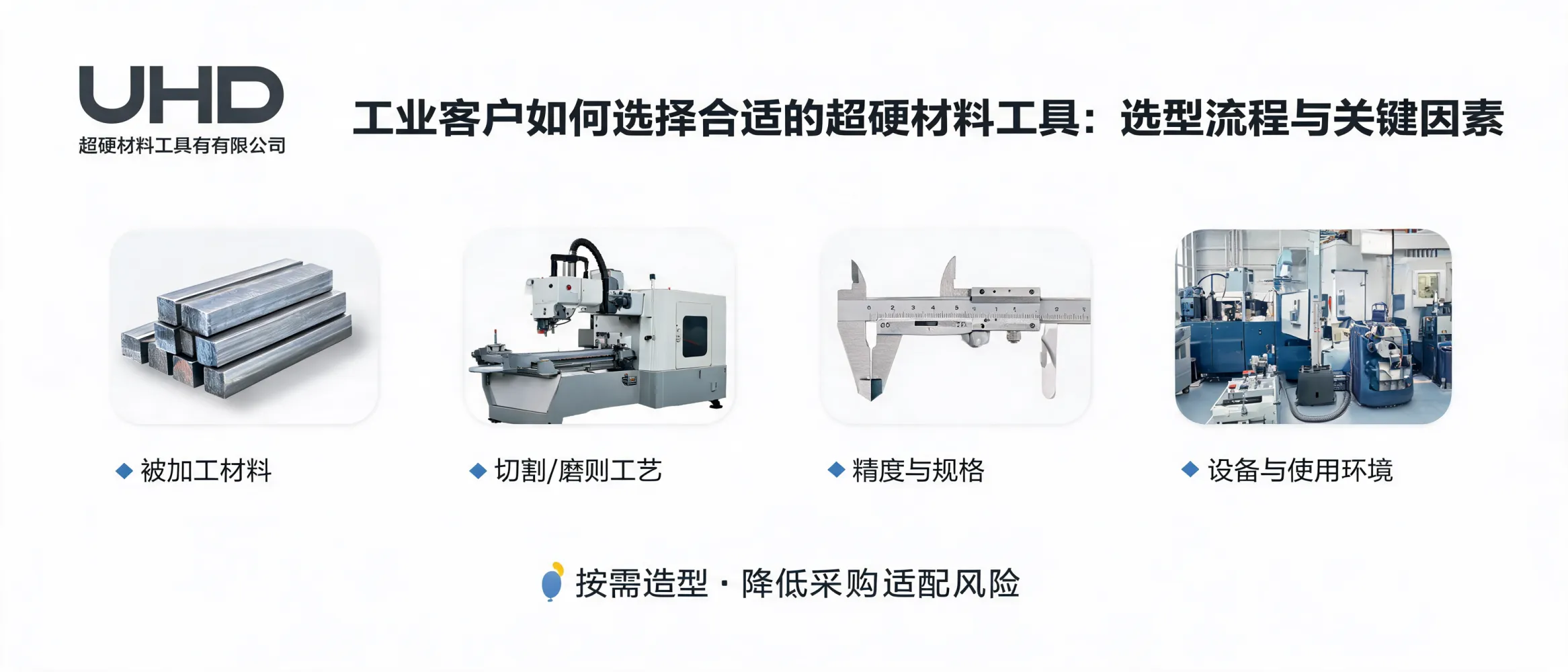
Selecting the right diamond tools for industrial cutting or grinding can quickly become expensive if it relies on trial-and-error. This guide from UHD Ultrahard Tools Co., Ltd provides a practical framework for buyers in metalworking and stone processing to align tool choice with workpiece material, process type, machine conditions, accuracy targets, throughput expectations, and tool life considerations.
UHD develops and manufactures ultrahard tooling, including diamond tools, abrasives, and custom vacuum-brazed diamond abrasive solutions for industrial applications.
Tool selection starts with understanding what you are machining. “Metal” and “stone” are broad categories—differences in hardness, abrasiveness, porosity, and thermal behavior directly affect diamond grit choice, bond design, and tool geometry.
Buyer tip: Provide a clear workpiece description (material name/grade if available, hardness range, surface condition) and a photo of the part or slab. This shortens the selection cycle and improves comparability across suppliers.
Different processes create different tool loads and performance priorities. A cutting application typically focuses on kerf control, stability, and edge integrity; grinding focuses on removal rate, surface finish, and temperature management.
| Selection factor | Cutting focus | Grinding focus |
|---|---|---|
| Primary KPI | Stable feed, controlled kerf, minimal chipping/burrs | Consistent removal rate, surface finish, low burn risk |
| Tool behavior | Straight tracking, vibration resistance | Uniform contact, controlled heat, predictable wear |
| Common pitfalls | Wandering cuts, edge breakout, premature segment wear | Glazing, overheating, inconsistent finish |
| What to specify | Cut depth, kerf tolerance, edge quality requirements | Target Ra/finish, stock removal per pass, allowed temperature rise |
Even a well-matched diamond tool can underperform if the machine, spindle, or fixture introduces vibration, runout, or unstable feed. Confirm the basics before changing tool specifications.
If performance varies widely between shifts or machines, document the setup (spindle, holder, coolant, operator parameters). This helps isolate whether the issue is tooling, parameters, or machine condition.
Industrial sourcing often mixes multiple goals—accuracy, finish, and throughput. The key is to prioritize which metric is most important for the operation, then select a tool configuration that supports that priority.
Focus on stability, controlled wear, and consistent cutting action. Specify tolerance/finish targets and the most critical surfaces or edges.
Focus on safe removal rate and heat control. Define cycle-time expectations and acceptable trade-offs (finish, post-processing allowance).
Focus on wear resistance and process consistency. Clarify whether “tool life” means parts per tool, meters cut, or hours in operation.
Many industrial applications can be served effectively with standard configurations. For complex geometries, unusual materials, or unstable processes, a custom approach—such as a vacuum-brazed diamond abrasive—can reduce iteration and improve repeatability.
| Decision point | Standard tool is often suitable when | Custom vacuum-brazed solution is often suitable when |
|---|---|---|
| Geometry & access | Open, conventional tool paths; standard sizes fit | Tight corners, special profiles, complex contact area |
| Material variability | Stable, well-understood material | Inclusions, inconsistent density, mixed material zones |
| Performance target | Balanced requirements; acceptable parameter window | Narrow parameter window; strict repeatability needs |
| Sourcing efficiency | Quick replacement and straightforward spec matching | You want to reduce re-testing by locking a spec to your process |
UHD supports both pathways—standard diamond tooling for typical operations and customized vacuum-brazed diamond abrasive specifications when the application requires tighter alignment to the process.
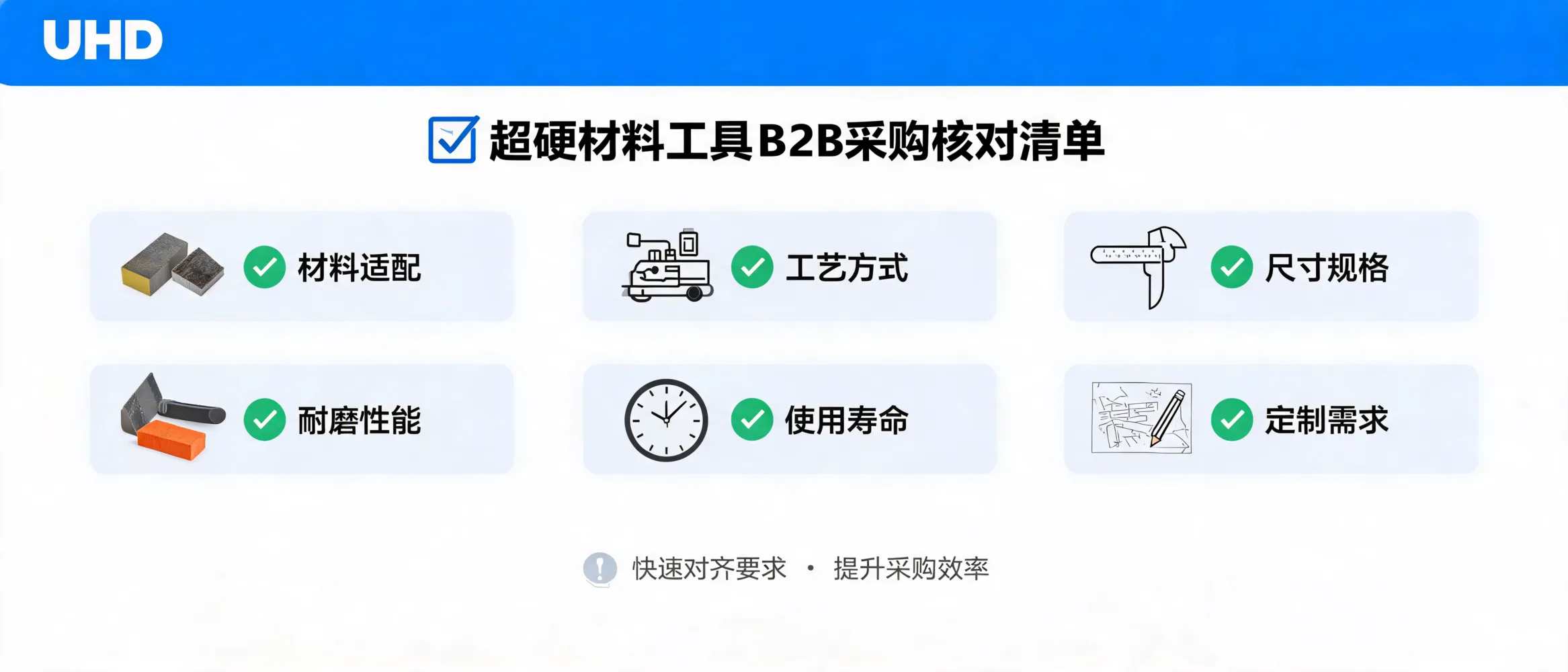
Use the workflow below to align internal stakeholders (production, quality, procurement) and communicate clearly with suppliers.
As a B2B manufacturer focused on ultrahard tooling, UHD Ultrahard Tools Co., Ltd combines production capability with application-oriented communication to help industrial buyers specify diamond tools with clearer boundaries and fewer iterations.
Tool performance and tool life depend on the interaction between material, machine condition, operating parameters, and operator practice. This page provides a selection framework to improve sourcing decisions; final results should be confirmed through controlled trials under your actual production conditions.


.png?x-oss-process=image/resize,h_1000,m_lfit/format,webp)