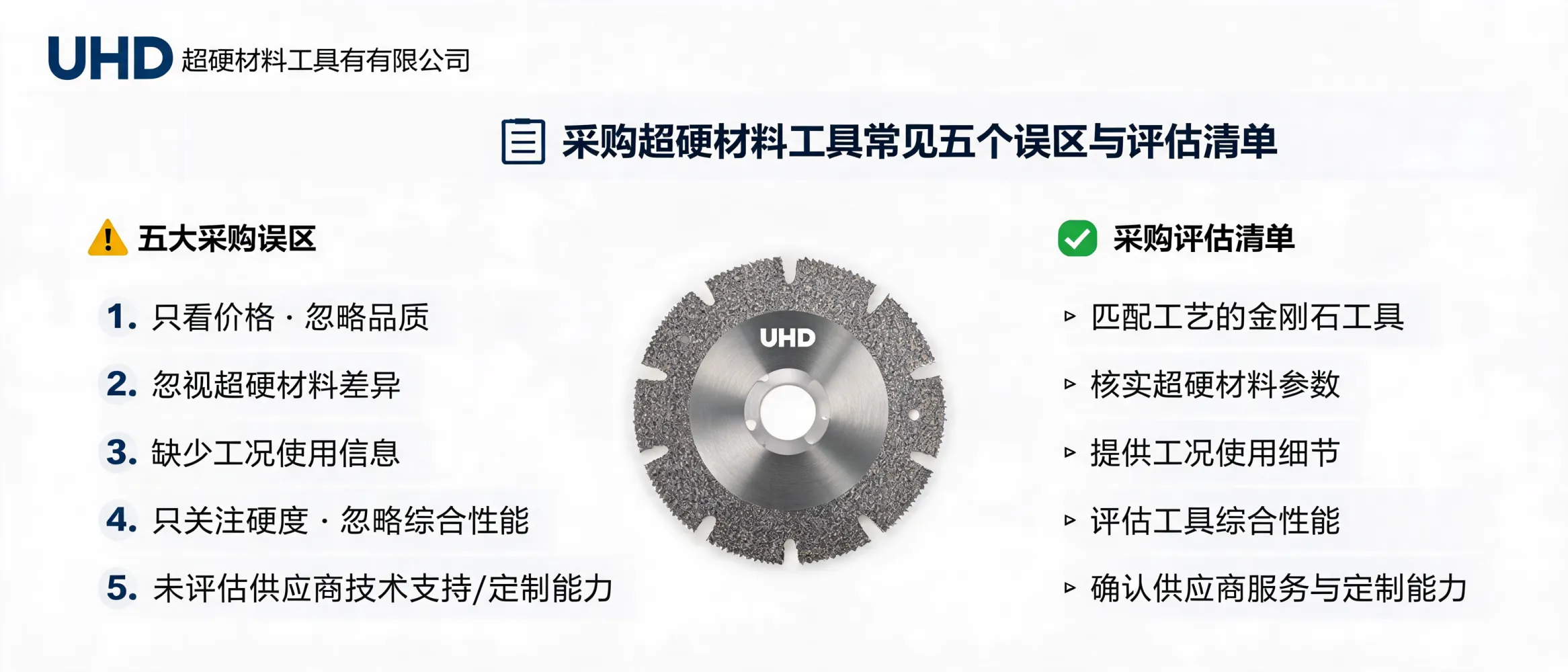
In industrial cutting and grinding, diamond tools are often purchased under time pressure and compared mainly by unit price. In practice, the “right” tool is the one that matches your material, process, and equipment—and is supported by a supplier who can help you stabilize performance over time.
This page from UHD Ultrahard Tools Co., Ltd (UHD) provides a buyer-friendly checklist to evaluate diamond tools beyond price, helping procurement, engineering, and production teams reduce avoidable trial-and-error and improve total cost of ownership (TCO) decisions.
Use the criteria below as a consistent framework when comparing diamond cutting or grinding tools. Each criterion is designed to be verifiable during RFQ, sampling, and production rollout.
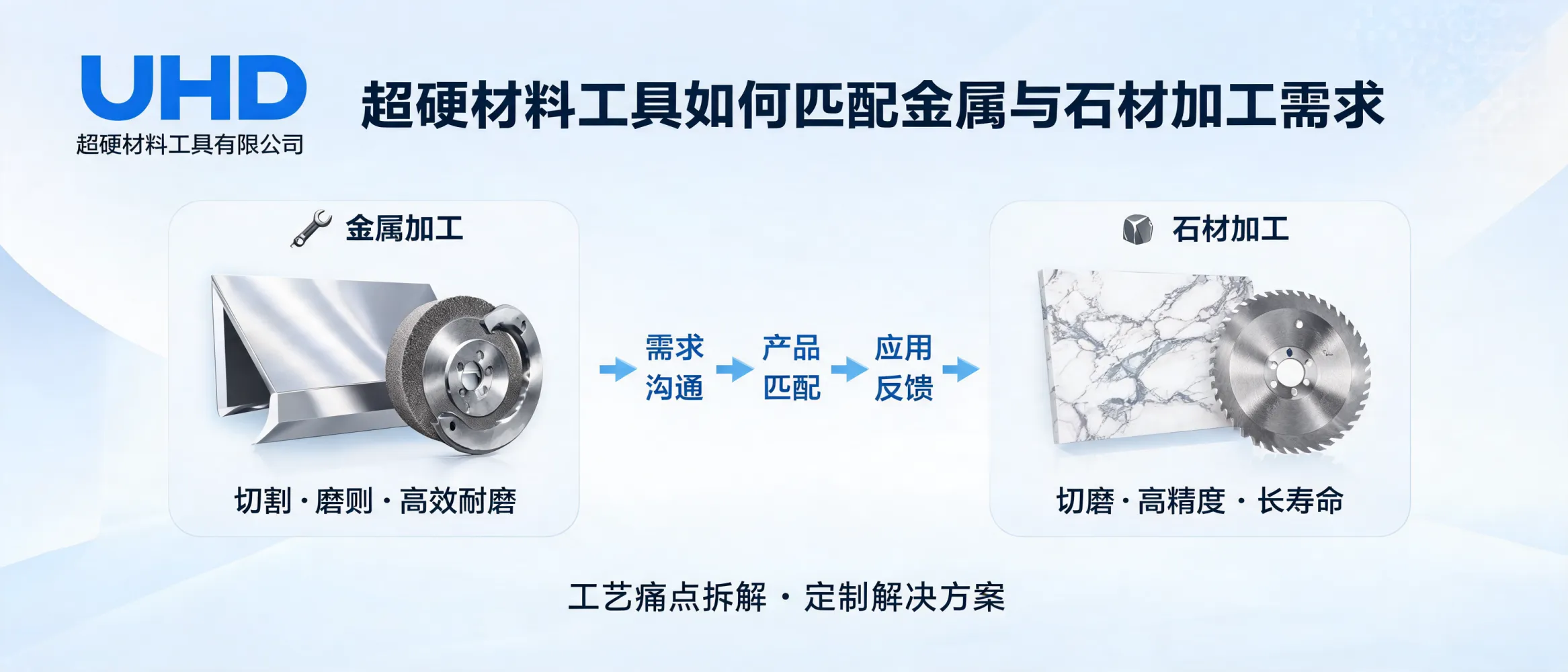
Identify the base material and its key characteristics (e.g., hardness, abrasiveness, brittleness, thermal sensitivity). Diamond tool performance depends heavily on matching the tool to the workpiece material—especially in metalworking and stone processing where wear mechanisms differ.
Buyer tip: Provide the material grade, surface condition, and whether the operation is continuous or intermittent—these details help suppliers recommend a more suitable tool structure and application parameters.
Confirm the tool’s key specifications: dimensions, segment/rim or abrasive layout, mounting interface, and geometry that affects chip removal and heat dissipation. Even small deviations can change vibration behavior, finish quality, and tool life.
Cutting and grinding place different demands on the diamond layer and the tool body. Define whether your priority is material removal rate, surface finish, edge integrity, dimensional control, or minimizing burn/chipping. The optimal tool design and application settings vary accordingly.
Tool performance depends on the machine’s spindle power, rigidity, RPM range, coolant capability, fixturing, and guarding limits. Ensure the tool is compatible with your equipment to prevent premature wear, vibration, and inconsistent results.
Compare tools on cost per part or cost per meter (as relevant), not only unit price. Consider tool change frequency, downtime, rework risk, and disposal/handling. A slightly higher-priced tool may be more economical if it reduces stoppages or stabilizes quality.
Recommended comparison fields
| Field | What to record | Why it matters |
|---|---|---|
| Tool life metric | Parts/meter/time until replacement | Enables fair TCO comparison |
| Changeover time | Minutes per tool change | Downtime impacts throughput |
| Quality stability | Chipping/burn marks/finish drift notes | Reduces rework and scrap risk |
| Operating window | Recommended speed/feed/coolant conditions | Improves repeatability at scale |
A diamond tool is part of a process system. Evaluate whether the supplier can support selection, sampling, and ramp-up with practical engineering input. Technical guidance can shorten iteration cycles and help maintain consistent performance across batches and production shifts.
UHD focuses on R&D, manufacturing, and B2B supply of ultrahard material tools, and works with research partners (e.g., universities) to strengthen product development—supporting industrial buyers who need tools aligned with specific process requirements.
To evaluate diamond tools efficiently, include the following information in your RFQ or technical inquiry. This helps suppliers respond with a suitable configuration instead of a generic quote.
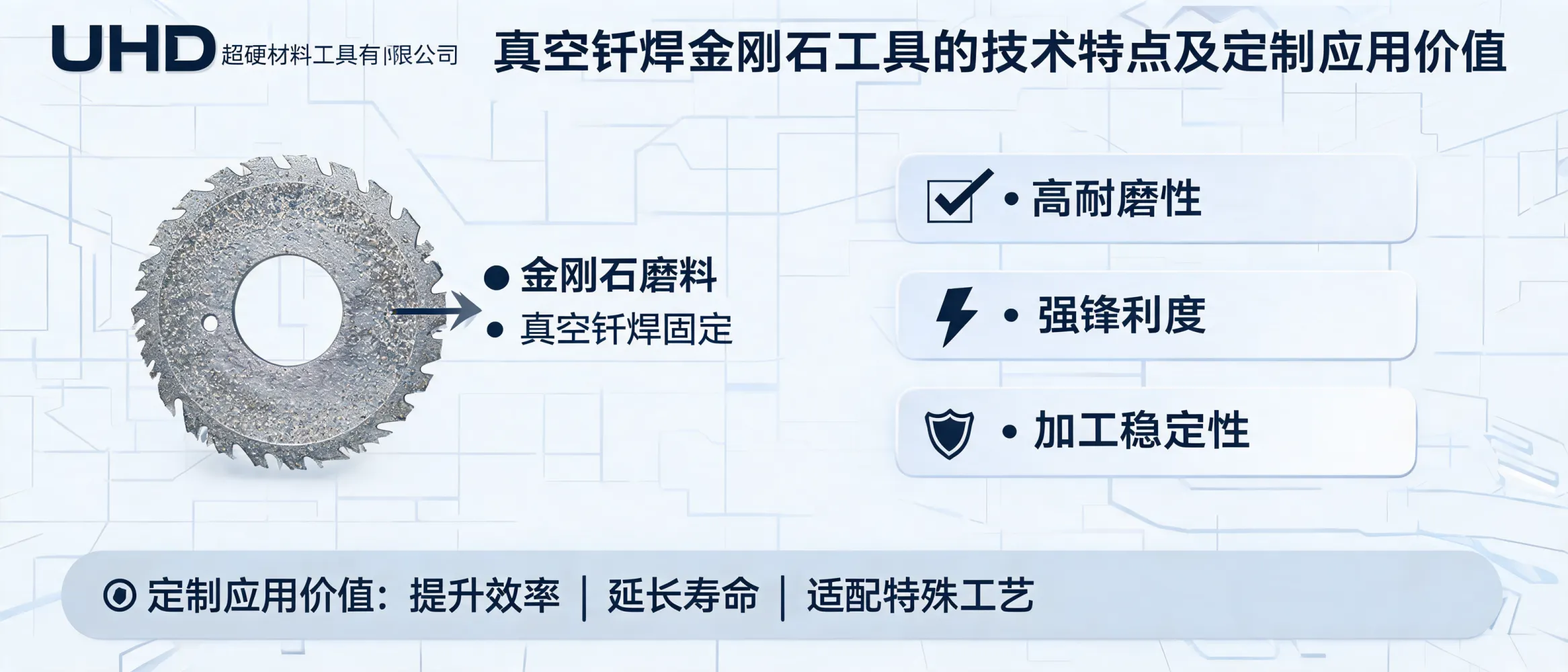
As a high-tech enterprise specializing in ultrahard material tools, UHD provides diamond tools and related solutions for industrial applications. Our product scope includes diamond tools, abrasives and grinding tools, and custom brazed diamond abrasives used in metal processing and stone processing scenarios.
We align recommendations with your workpiece material, process goals, and machine conditions—so the proposed tool configuration is grounded in application constraints.
UHD operates an established B2B foreign trade service system and works with global buyers through international platforms—helping keep technical requirements, quality expectations, and delivery coordination clear.
If you are evaluating diamond tools for an industrial cutting or grinding line, use the six criteria above to structure internal reviews and supplier comparisons. For application-oriented tool selection and customization discussions, UHD Ultrahard Tools Co., Ltd can support your team with a clearer specification path and practical technical communication.
.png?x-oss-process=image/resize,h_1000,m_lfit/format,webp)