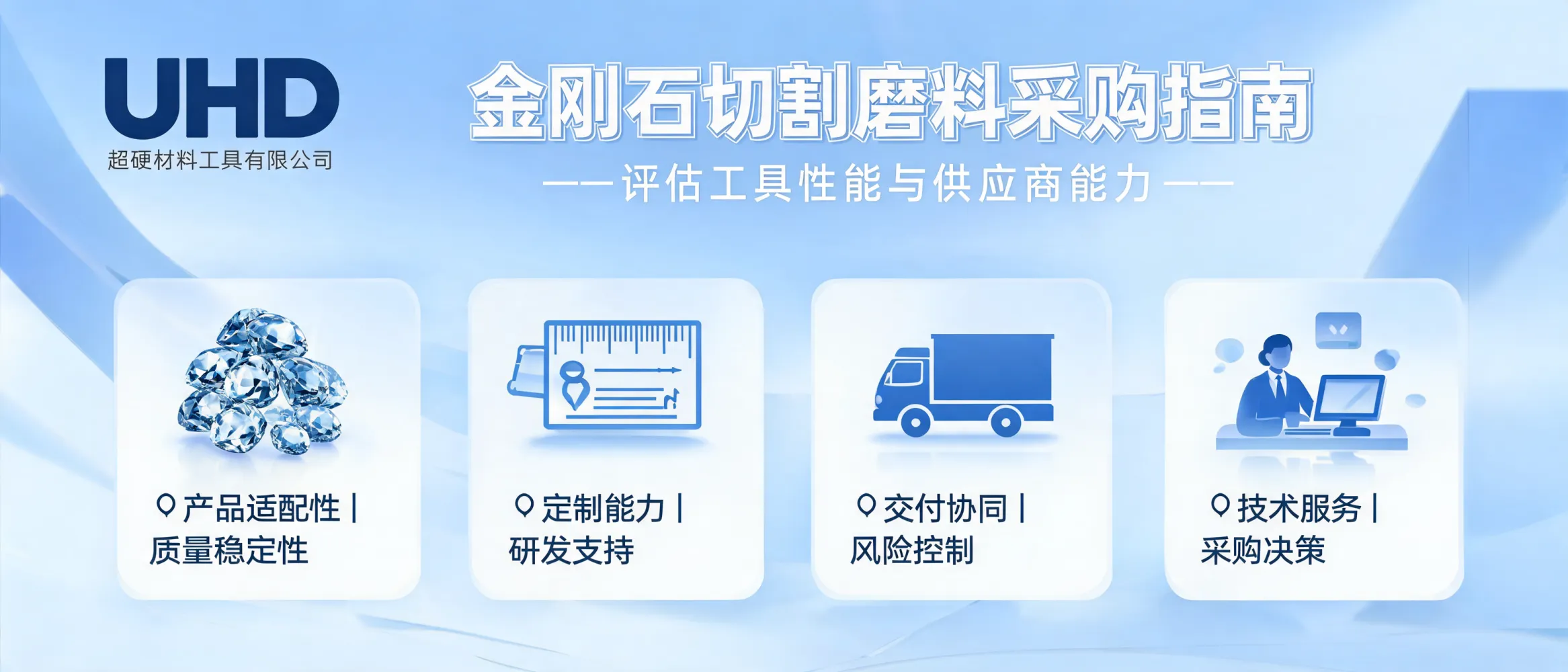
Diamond Cutting Abrasives Purchasing Guide: Evaluating Performance, Quality Consistency, and Supplier Support
21 07,2026
UHD Ultrahard Tools Co., Ltd
Industry Guide
This purchasing guide from UHD Ultrahard Tools Co., Ltd helps industrial buyers, engineers, and production teams assess diamond cutting abrasives by application fit, quality consistency, customization capability, R&D support, delivery coordination, and technical service—building a practical supplier evaluation framework for purchasing decisions.
Selecting diamond cutting abrasives for industrial production is not only a tooling choice—it is a decision that affects cutting stability, scrap risk, and process continuity. This guide provides a practical framework for industrial procurement, process engineers, and production teams to evaluate tool performance and verify supplier capability in a structured, comparable way.
Guide scope: Diamond cutting abrasives supplier evaluation for industrial procurement, process engineering, and production teams—covering application fit, cutting efficiency, wear behavior, batch consistency, customization, R&D/process support, delivery coordination, and after-sales technical service.
1) Start with Application Fit (Material • Process • Machine)
A “good” abrasive is defined by fit to your specific conditions. Before comparing brands or pricing, align on the fundamentals so that test results are meaningful and repeatable.
-
Work material: metal vs. stone; hardness level; presence of inclusions; surface coating or oxide layer.
-
Process goal: cutting vs. grinding; roughing vs. finishing; target edge quality and dimensional tolerance.
-
Machine & setup: spindle power, rigidity, coolant condition, clamping, feed strategy, and allowable vibration range.
-
Tool form factor constraints: size, mounting, runout tolerance, and safety limits relevant to your equipment.
Procurement tip: When requesting quotes or samples, provide a short “process card” (material + operation + machine + target output). This reduces mismatches and shortens supplier validation cycles.
2) Evaluate Tool Performance: Cutting Efficiency & Wear Behavior
Performance evaluation should combine productivity indicators with wear stability. One-time “fast cutting” results are not enough—focus on behavior over time and across parts.
Efficiency indicators (what to observe)
- Material removal behavior at your set feed/speed
- Cutting stability (chatter tendency, load fluctuation)
- Heat impact (burning/discoloration where relevant)
- Surface/edge outcome consistent with process goals
Wear & failure modes (what to record)
- Wear pattern consistency (uniform vs. localized)
- Edge integrity and micro-chipping tendencies
- Unexpected early failure signals (cracking, segment loss where applicable)
- Tool life repeatability under the same parameters
Engineering alignment: Agree internally on the primary KPI (cycle time, tool life, surface quality, or stability). The “best” diamond cutting abrasive depends on which constraint limits your line today.
3) Verify Batch-to-Batch Quality Consistency
For industrial buyers, the hidden cost is often not the sample—it is the variance after approval. Consistency validation should cover incoming inspection, usage behavior, and feedback closure.
| Checkpoint |
What to compare across batches |
Why it matters |
| Incoming inspection |
Appearance, dimensions, mounting fit, basic runout checks (as applicable) |
Prevents avoidable line issues and unplanned rework |
| Process performance |
Cut stability, wear progression, tool life scatter under the same parameters |
Ensures predictable throughput and scheduling |
| Traceability & closure |
Lot identification, change notifications, response time on deviations |
Improves accountability and accelerates corrective actions |
Practical approach: Run a small, controlled cross-batch verification (e.g., multiple shipments or lots) before scaling volume. Document process parameters to avoid mixing tool variance with setup variance.
4) Assess Customization Capability (Especially for Brazed Diamond Abrasives)
Many production lines require abrasives that are adapted to a specific geometry, mounting method, or process window. Evaluate whether the supplier can support customization responsibly—without destabilizing lead time or quality control.
- Requirement intake quality: whether the supplier asks for key process conditions and constraints before recommending specifications
- Design-to-test loop: ability to propose iterations based on trial feedback (parameters, wear, surface outcome)
- Change control: clarity on what happens when material, geometry, or process updates occur
- Consistency under customization: capacity to keep performance stable after design adjustments
5) Evaluate R&D and Process Support (Beyond the Quote)
Strong supplier support reduces ramp-up time and improves the quality of your internal decision-making. A capable partner can help your team identify root causes when results differ between trials and production.
What “support” should include
- Parameter recommendations aligned to your machine and process
- Troubleshooting guidance based on wear and failure observations
- Clear communication of design intent and usage boundaries
Signals of technical depth
- Ability to discuss ultrahard tool behavior across metal and stone processing contexts
- Structured test planning rather than ad-hoc sampling
- Collaboration mechanisms for continuous improvement
6) Delivery Coordination & B2B Collaboration
Supplier evaluation should also cover operational fit: how smoothly the supplier can support your planning, shipping requirements, and documentation needs in international B2B workflows.
- Lead-time reliability: clarity on production scheduling and realistic shipment commitments
- Packaging & protection: appropriate protection to reduce damage risk in transit
- Communication cadence: proactive updates when changes occur (materials, specs, delivery plans)
- Export readiness: ability to work with common B2B trade processes and documentation expectations
7) After-Sales Technical Service: What to Expect
Effective after-sales service is not “replacement promises”—it is structured technical response that helps restore stable production. Define service expectations early so responsibilities are clear when deviations happen.
- Issue intake: what photos/measurements are needed, and expected response time
- Root-cause reasoning: analysis based on application conditions and wear evidence
- Corrective action path: parameter adjustments, tool spec refinement, and change control
How UHD Supports Industrial Evaluation & Long-Term Supply
UHD Ultrahard Tools Co., Ltd (河南优德超硬工具有限公司) is a high-tech enterprise focused on the R&D, manufacturing, and supply of ultrahard material tools, including diamond tools and brazed diamond abrasives, serving industrial metal and stone processing applications. UHD emphasizes application-oriented product positioning, quality-focused manufacturing, and professional technical collaboration to support customers through selection, validation, and ongoing production use.
Technical foundation
UHD maintains R&D strength and collaborates with academic partners such as Henan University of Technology to support ultrahard tool development and process-focused improvement.
B2B service readiness
With an established international B2B trade workflow, UHD supports structured communication and coordination for global buyers through common trade platforms and standard collaboration practices.
What to prepare for an effective supplier evaluation
- Your application details (material, operation, machine, coolant/dry, constraints)
- Target KPI (cycle time, tool life stability, surface/edge requirement, scrap control)
- Current pain points (wear mode, vibration, heat marks, inconsistency)
- Preferred validation method (trial plan, batch check, acceptance criteria)
Using the evaluation framework on this page, your team can compare diamond cutting abrasives more consistently—while also assessing whether the supplier can support stable production through customization, technical collaboration, and dependable delivery coordination.


.png?x-oss-process=image/resize,h_1000,m_lfit/format,webp)

.png?x-oss-process=image/resize,h_1000,m_lfit/format,webp)