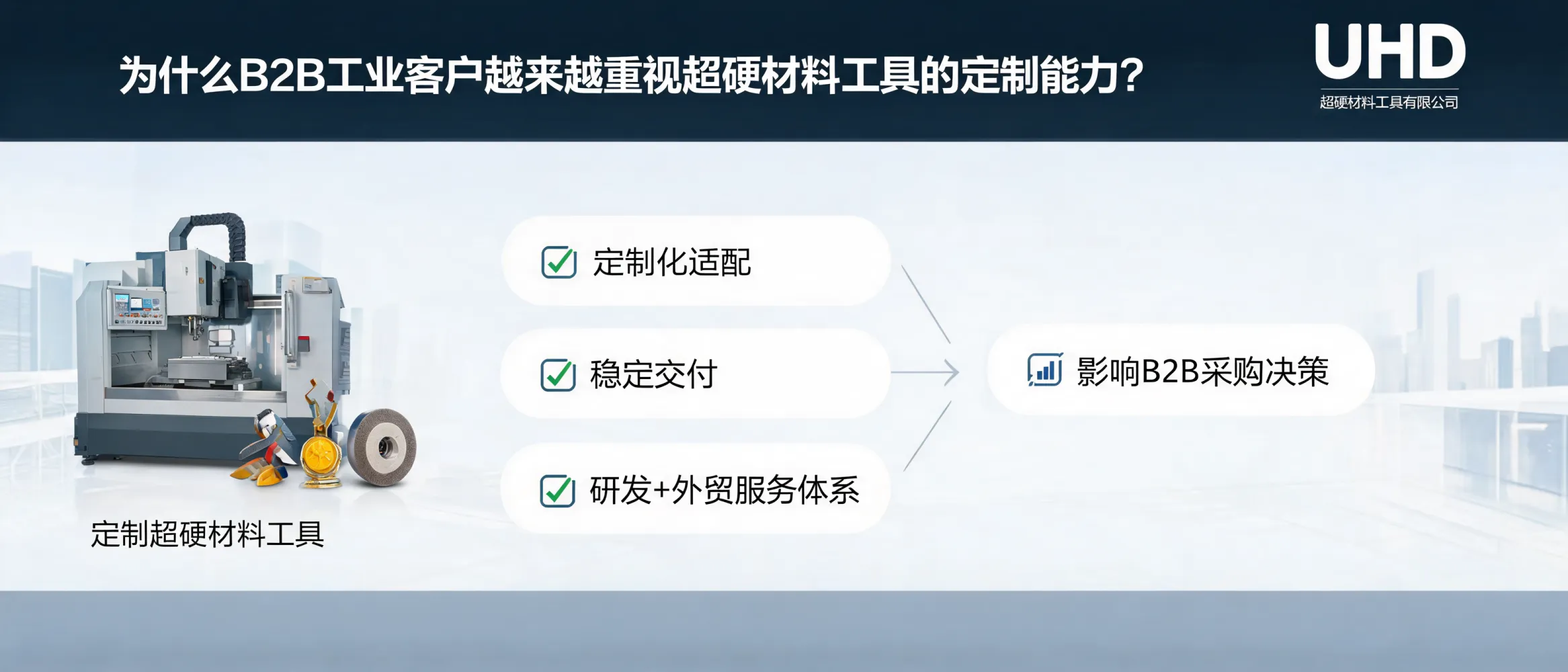
Industrial sourcing teams often lose money on diamond cutting abrasives not because of the product category itself, but because of how the buying decision is made. Comparing only unit price can hide differences in bond, diamond grade, tool geometry, and fit-to-machine—leading to unstable results, unexpected downtime, and higher total cost.
This page from UHD Ultrahard Tools Co., Ltd outlines five common procurement mistakes when sourcing diamond cutting abrasives and related grinding tools, and provides a practical supplier evaluation checklist focused on performance, Total Cost of Ownership (TCO), delivery, quality consistency, and customization/engineering support.
Unit price is measurable, but it rarely reflects what matters in production: material removal rate, tool life, rework rate, scrap risk, changeover time, and downtime. A “cheaper” abrasive can become expensive if it wears fast or causes inconsistent surface finish.
“Diamond abrasive” is not a single universal solution. Performance depends on matching the tool specification to the workpiece material and the process target (cutting speed, edge quality, surface finish, thermal sensitivity).
Even a well-designed diamond cutting abrasive can underperform if it is not aligned with the machine’s capabilities and the process window. Procurement issues often happen when orders are placed without confirming the parameters that influence cutting/grinding behavior.
| Category | What to provide | Why it matters |
|---|---|---|
| Machine | Spindle speed range, power/torque, rigidity, runout, coolant system | Determines feasible cutting/grinding window and heat control |
| Setup | Mounting method, flange/adapter spec, alignment constraints | Prevents vibration, wobble, and uneven wear |
| Process | Feed rate, depth of cut, pass strategy, wet/dry requirement | Directly affects tool life, finish, and dimensional stability |
| Quality target | Surface finish/edge limits, inspection method, defect criteria | Aligns “good part” definition for evaluation and acceptance |
Tip: provide photos of the current tool wear pattern and the workpiece result—this often speeds up root-cause analysis and spec matching.
“Tool life” is only meaningful under defined conditions. A reliable procurement process includes a controlled validation plan so that results can be compared across suppliers and batches.
Diamond cutting abrasives are a performance component. When issues occur (unexpected wear, overheating, unstable finish), the difference between suppliers is often response speed, diagnostic capability, and customization support—not just catalog availability.
A supplier who can translate your material + machine + quality target into a stable tool specification reduces procurement risk—even when the per-unit price is not the lowest.
Use this checklist when qualifying or re-evaluating diamond abrasive suppliers. It is designed to support repeatable decisions for industrial purchasing and engineering teams.
| Evaluation area | Questions to ask / evidence to request | What it reduces |
|---|---|---|
| Cutting / grinding results | Defined performance targets, trial plan, wear analysis method, spec matching logic | Yield loss, rework, unstable output |
| Total cost (TCO) | Tool life measurement approach, changeover frequency, impact on cycle time and scrap | Hidden costs masked by unit price |
| Delivery capability | Lead time stability, packing/labeling, communication cadence for order updates | Line stoppage and planning disruption |
| Quality consistency | Incoming inspection guidance, batch traceability approach, change control notification | Batch-to-batch variation, unexpected failures |
| Customization & engineering support | Ability to adjust tool spec for materials/machines, feedback loop during trials, technical response time | Slow troubleshooting, repeated re-qualification |
UHD Ultrahard Tools Co., Ltd focuses on R&D, manufacturing, and B2B supply of ultrahard material tools, including diamond tools, abrasives, and custom brazed diamond abrasives used in metalworking and stone processing. Our approach is to help buyers specify and validate diamond cutting abrasives based on material, machine parameters, and performance targets, rather than relying on unit price comparisons.
If you are building a supplier approval workflow for diamond cutting abrasives, this page can be used as a common reference between purchasing and engineering to reduce qualification risk and improve decision consistency.
Brand: UHD Ultrahard Tools (河南优德超硬工具有限公司) | Industry: Ultrahard material tools & diamond abrasives (B2B)
Procurement note: align specs, parameters, and validation criteria before comparing prices.
.png?x-oss-process=image/resize,h_1000,m_lfit/format,webp)

.png?x-oss-process=image/resize,h_1000,m_lfit/format,webp)